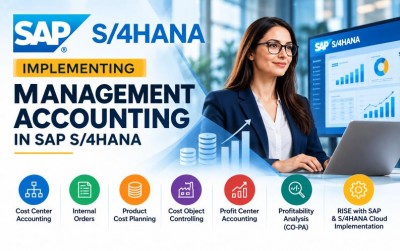
The Implementing Management Accounting in SAP S/4HANA Training
is designed for SAP Finance Consultants, SAP CO Consultants, Management
Accountants, Cost Accountants, Financial Analysts, ERP Consultants, and
implementation professionals who want to develop expertise in SAP S/4HANA
Management Accounting and prepare for SAP certification.
Throughout this comprehensive course, learners will gain practical knowledge
of Cost Center Accounting, Internal Orders, Product Cost Planning, Cost Object
Controlling, Profit Center Accounting, Profitability Analysis (CO-PA), and
implementation methodologies using SAP S/4HANA Cloud Private Edition. The
curriculum combines business concepts with real-world SAP implementation
scenarios to prepare learners for enterprise implementation projects.
By the end of this course, participants will be able to configure,
customize, implement, and support SAP Management Accounting solutions while
integrating controlling processes with Financial Accounting (FI), Materials
Management (MM), Production Planning (PP), Sales & Distribution (SD), and
SAP Analytics tools.
The learning journey is designed as an entry-level certification for Management Accounting consultants and covers organizational units, master data, overhead cost accounting, product cost planning, cost object controlling, profitability analysis, periodic activities, reporting, and SAP S/4HANA Cloud Private Edition implementation
Modern organizations require accurate cost management, profitability
analysis, budgeting, planning, and financial performance monitoring to remain
competitive. SAP S/4HANA Management Accounting provides a centralized platform
for controlling business costs, analyzing profitability, planning financial
performance, and supporting strategic business decisions with real-time
analytics.
This comprehensive training program introduces learners to the complete
Management Accounting lifecycle within SAP S/4HANA. Participants will explore
Cost Center Accounting, Internal Orders, Product Cost Planning, Cost Object
Controlling, Profit Center Accounting, Profitability Analysis (CO-PA), SAP
Analytics Cloud planning integration, and SAP implementation methodologies.
The course emphasizes practical business scenarios, SAP configuration,
period-end closing activities, planning, budgeting, reporting, and
implementation best practices. Learners will understand how Management
Accounting integrates with other SAP modules while supporting enterprise-wide
financial transparency and operational excellence.
By combining functional knowledge with implementation-focused learning, this
course prepares professionals to participate in SAP S/4HANA implementation
projects, support financial controlling operations, and pursue SAP Management
Accounting certification.
The curriculum includes seven modules covering Cost Center & Internal
Orders, Product Cost Planning, Cost Object Controlling, Profit Center
Accounting, Profitability Analysis, RISE with SAP Methodology, and SAP S/4HANA
Cloud Private Edition implementation.
continue
Upon successful completion of this course, learners will be able to:
These learning outcomes are based on the curriculum covering Organizational Units, Cost Center Accounting, Product Cost Planning, Cost Object Controlling, Profit Center Accounting, Profitability Analysis, RISE with SAP Methodology, and SAP S/4HANA Cloud Private Edition implementation.
This course is ideal for:
This module introduces the design and structure of cost elements, cost
centers, internal orders, planning, budgeting, period-end closing, and
commitment management. Learners will understand how overhead costs flow through
SAP S/4HANA and how Management Accounting integrates with Financial Accounting
and other SAP modules.
By the end of this module, participants will be able to configure Cost
Center Accounting and Internal Orders, execute planning and budgeting
activities, perform period-end processing, and manage cost allocations
efficiently.
According to the curriculum, this module covers Cost Center Accounting,
Organizational Units, Master Data, Event-Based Postings, Internal Orders,
Planning, Budgeting, Availability Control, and Commitment Management. 70 -
Implementing Management Ac…
After completing this module, you will be able to:
SAP S/4HANA provides a simplified and intelligent platform for enterprise
financial management by integrating Financial Accounting and Management
Accounting into a single data model. Cost Center Accounting and Internal Orders
play a vital role in controlling operational costs and improving organizational
performance.
This unit introduces the SAP S/4HANA architecture, Management Accounting
concepts, integration with Financial Accounting, and the role of Cost Centers
and Internal Orders in enterprise cost management.
Effective Management Accounting begins with properly configured
organizational structures and master data. Cost Centers, Cost Elements, Profit
Centers, and related master data ensure accurate cost allocation and reporting
across business units.
This unit explains how organizational units are defined, how master data is
maintained, and how these elements support enterprise-wide cost control.
Event-Based Postings enable organizations to record financial transactions
in real time, ensuring accurate cost allocation and immediate visibility into
operational expenses. SAP S/4HANA automatically updates Management Accounting
whenever relevant business events occur.
This unit introduces event-based accounting concepts, transaction
processing, integration with Financial Accounting, and real-time cost postings.
Period-End Closing activities ensure that all operational costs are accurately allocated and financial reports reflect the true financial position of the organization. These activities include allocations, settlements, assessments, and reconciliations.
This unit explains the period-end closing process, allocation cycles, settlements, reconciliation procedures, and financial reporting.
Internal Orders are temporary cost objects used to monitor costs for projects, maintenance activities, marketing campaigns, events, and other internal business activities. They provide detailed tracking of expenses beyond traditional cost center accounting.
This unit introduces Internal Order master data, order types, planning, budgeting, lifecycle management, and integration with other SAP modules.
SAP S/4HANA records costs directly against Internal Orders whenever business transactions occur. These event-based postings provide real-time monitoring of project and operational expenses while ensuring accurate accounting integration.
This unit explains posting logic, accounting integration, document flow, and reporting for Internal Orders.
Internal Orders require structured period-end activities to ensure accumulated costs are settled appropriately to Cost Centers, Assets, Profitability Analysis, or other controlling objects. Proper settlement supports accurate financial reporting and project evaluation.
This unit explains settlement rules, order closing, allocations, reconciliations, and reporting activities for Internal Orders.
Planning enables organizations to forecast operational expenses, allocate financial resources effectively, and monitor performance against budgets. SAP S/4HANA supports comprehensive planning using Analysis for Office and SAP Analytics Cloud.
This unit introduces planning methods, budgeting processes, forecasting techniques, and planning integration with SAP Analytics Cloud.
Budgeting ensures that departments and projects operate within approved financial limits. Availability Control automatically monitors expenditures and prevents overspending by comparing actual costs against allocated budgets.
This unit explains budget creation, availability control configuration, budget monitoring, and exception handling.
Commitment Management enables organizations to monitor future financial commitments such as purchase requisitions, purchase orders, and planned expenditures before actual costs are incurred. This provides greater visibility into future obligations and improves budget control.
This unit introduces commitment management concepts, commitment postings, reporting, and integration with procurement and financial accounting.
This module introduces Product Cost Planning within SAP S/4HANA, covering
costing methods, material cost estimates, quantity structures, configuration
settings, valuation methods, and additional costing functions. Learners will
understand how SAP integrates Product Cost Planning with Production Planning
(PP), Materials Management (MM), Financial Accounting (FI), and Controlling
(CO) to provide accurate cost information.
By the end of this module, participants will be able to configure Product
Cost Planning, perform material cost estimates, analyze costing results, and
support enterprise manufacturing cost management.
According to the curriculum, this module covers Product Cost Planning
Methods, Product Cost Planning Basics, Material Cost Estimates, Quantity
Structure Costing, Product Cost Planning Configuration, Additional Costing
Functions, and Additional Valuation Methods. 70 - Implementing Management Ac…
After completing this module, you will be able to:
Product Cost Planning enables organizations to calculate product costs using
different costing methodologies based on manufacturing requirements and
business objectives. Selecting the appropriate costing method ensures accurate
product valuation and supports effective pricing decisions.
This unit introduces the various Product Cost Planning methods available in
SAP S/4HANA, including standard costing approaches, planning strategies, and
integration with manufacturing processes.
Effective Product Cost Planning begins with understanding the relationships between master data, bills of materials, routing information, costing variants, and organizational structures. These components work together to generate accurate product cost estimates.
This unit explains the fundamental concepts of Product Cost Planning, key master data requirements, costing structures, and integration with other SAP modules.
Material Cost Estimates without Quantity Structure are used when detailed production data such as Bills of Materials or Routings are unavailable. This approach allows organizations to estimate product costs manually using predefined costing information.
This unit explains manual costing methods, material cost estimates, planning scenarios, and valuation techniques within SAP S/4HANA.
Configuration settings define how Product Cost Planning calculates costs, determines valuation methods, selects costing variants, and integrates with financial accounting. Proper configuration ensures consistent and reliable product costing across the organization.
This unit introduces Product Cost Planning configuration, costing variants, valuation strategies, account determination, and system settings.
Material Cost Estimates with Quantity Structure use production master data such as Bills of Materials (BOM) and Routings to calculate product costs automatically. This method provides highly accurate manufacturing cost estimates based on actual production processes.
This unit explains quantity structure costing, production integration, automatic cost calculation, and manufacturing cost analysis.
SAP S/4HANA provides additional costing functions that enhance Product Cost Planning by supporting special costing scenarios, advanced calculations, and business-specific requirements. These functions help organizations improve costing accuracy and flexibility.
This unit introduces additional costing capabilities, special costing scenarios, advanced calculations, and configuration options.
Different organizations require different valuation methods depending on accounting standards, business requirements, and manufacturing strategies. SAP S/4HANA supports multiple valuation approaches to ensure accurate financial reporting and product costing.
This unit explains additional valuation methods, valuation strategies, financial reporting implications, and integration with Management Accounting.
This module introduces the Cost Object Controlling component of SAP S/4HANA
Management Accounting. Learners will explore Product Cost by Period, Product
Cost by Order, Sales Order Costing, period-end processing, reporting, and
configuration. The module also explains how Cost Object Controlling integrates
with Production Planning (PP), Materials Management (MM), Sales &
Distribution (SD), and Financial Accounting (FI).
By the end of this module, participants will be able to configure Cost
Object Controlling, execute manufacturing costing processes, perform period-end
activities, and analyze production costs using SAP S/4HANA.
According to the curriculum, this module covers Controlling Object Cost,
Product Cost by Period, Product Cost by Order, Sales Order Costing, Information
Systems, Configuration, and Period-End Closing.
After completing this module, you will be able to:
Cost Object Controlling provides organizations with a structured approach to monitor production costs throughout the manufacturing process. It enables businesses to collect, analyze, and allocate costs to products, production orders, and sales orders while supporting profitability analysis and financial reporting.
This unit introduces Cost Object Controlling concepts, controlling objects, manufacturing cost collection, and business process integration within SAP S/4HANA.
Product Cost by Period is designed for repetitive manufacturing and process manufacturing environments where production costs are accumulated over a specific accounting period instead of individual production orders. This approach simplifies cost collection and supports efficient period-end cost analysis.
This unit explains period-based costing methods, cost collection, work-in-process calculations, variance analysis, and settlement procedures.
Product Cost by Order enables organizations to calculate and monitor production costs for individual manufacturing orders. This approach provides detailed cost tracking throughout the production lifecycle and supports accurate profitability analysis.
This unit explains production order costing, cost collection, confirmations, settlements, variance calculations, and manufacturing reporting.
Sales Order Costing is used for engineer-to-order and make-to-order manufacturing scenarios where costs are collected and analyzed at the individual sales order level. This enables organizations to evaluate customer-specific profitability and project performance.
This unit introduces sales-order-related costing, revenue matching, profitability tracking, settlement processes, and financial integration.
SAP S/4HANA provides comprehensive reporting and analytical tools for monitoring manufacturing costs, production efficiency, variances, and profitability. These reports enable managers to make informed operational and strategic decisions.
This unit explains Cost Object Information Systems, reporting tools, manufacturing analytics, variance reporting, and performance monitoring.
Configuration settings determine how manufacturing costs are collected, calculated, settled, and reported within SAP S/4HANA. Proper configuration ensures consistent costing procedures across manufacturing processes and organizational units.
This unit introduces configuration settings, costing variants, settlement profiles, valuation methods, and integration with Financial Accounting and Production Planning.
Period-End Closing is a critical process that ensures manufacturing costs are accurately calculated, settled, and reflected in financial statements. Activities include work-in-process calculations, variance determination, settlement, and reconciliation.
This unit explains the sequence of period-end closing activities, financial reconciliation, manufacturing settlements, and reporting.
This module introduces Profit Center Accounting within SAP S/4HANA
Management Accounting. Learners will explore organizational units, master data,
planning, transfer pricing, information systems, reporting, and period-end
closing activities. The module also explains how Profit Center Accounting
integrates with Financial Accounting (FI), Controlling (CO), Sales &
Distribution (SD), Materials Management (MM), and Production Planning (PP).
By the end of this module, participants will be able to configure Profit
Center Accounting, manage profit center structures, execute planning
activities, process transfer pricing, and generate profitability reports for
effective business performance analysis.
According to the curriculum, this module covers Organizational Units, Master
Data, Planning, Profit Center Information Systems, Transfer Prices, and
Period-End Closing in Profit Center Accounting. 70 - Implementing Management
Ac…
After completing this module, you will be able to:
Profit Center Accounting enables organizations to measure the profitability of different areas of responsibility independently. By assigning revenues and expenses to specific profit centers, businesses gain visibility into operational performance and can evaluate which business units contribute most effectively to organizational profitability.
This unit introduces the objectives, architecture, business benefits, and integration of Profit Center Accounting within SAP S/4HANA.
A well-defined organizational structure and accurate master data are essential for effective Profit Center Accounting. Proper configuration enables consistent financial reporting, accurate allocations, and streamlined business operations across multiple organizational entities.
This unit explains the configuration of organizational units, Profit Center master data, hierarchies, assignments, and integration with other SAP components.
Planning enables organizations to establish financial targets, forecast revenues and expenses, and evaluate business performance against planned objectives. SAP S/4HANA provides integrated planning capabilities that support budgeting, forecasting, and profitability analysis.
This unit introduces planning processes, planning layouts, forecasting techniques, and integration with SAP Analytics Cloud and Analysis for Office.
Transfer Pricing enables organizations to value transactions between internal business units while maintaining compliance with accounting standards and tax regulations. SAP S/4HANA supports multiple valuation approaches for internal trading and management reporting.
This unit explains transfer pricing concepts, valuation methods, legal and management views, and integration with Profit Center Accounting.
SAP S/4HANA provides powerful reporting and analytical capabilities that enable managers to evaluate profitability, compare planned versus actual performance, and identify improvement opportunities across business units.
This unit introduces Profit Center Information Systems, analytical reports, KPIs, dashboards, and financial performance monitoring tools.
Period-End Closing ensures that all revenues, expenses, allocations, and adjustments are accurately reflected within Profit Center Accounting. These activities support accurate financial reporting and profitability analysis while maintaining consistency across organizational units.
This unit explains allocation cycles, reconciliation, assessments, settlements, financial closing, and reporting activities for Profit Center Accounting.
Profitability Analysis (CO-PA) is one of the most powerful components of SAP S/4HANA Management Accounting, enabling organizations to evaluate business performance by analyzing revenues, costs, contribution margins, and profitability across multiple business dimensions such as products, customers, market segments, sales organizations, and geographical regions.
This module introduces Profitability Analysis (CO-PA) within
SAP S/4HANA, covering organizational units, master data, profitability
planning, reporting, information systems, and profitability analysis
techniques. Learners will understand how SAP integrates operational and
financial data to provide real-time profitability insights that support
strategic business decisions.
By the end of this module, participants will be able to
configure CO-PA, perform profitability planning, analyze contribution margins,
and generate comprehensive profitability reports using SAP S/4HANA.
According to the curriculum, this module covers
Organizational Units, Master Data, Planning, Information Systems, and
Profitability Analysis reporting.
What You Will Learn
After completing this module, you will be able to:
Unit Description
Profitability Analysis helps organizations measure the financial performance of products, customers, business units, and market segments. It enables management to understand where profits are generated and identify opportunities to improve operational efficiency and business performance.
This unit introduces the objectives, architecture, benefits, and business applications of Profitability Analysis within SAP S/4HANA.
Key Topics
Unit Description
Accurate organizational structures and master data form the foundation of Profitability Analysis. Characteristics, value fields, operating concerns, and organizational assignments ensure that profitability information is captured consistently across all business processes.
This unit explains the configuration of CO-PA organizational units, operating concerns, characteristics, value fields, and master data integration.
Key Topics
Unit Description
Profitability Planning enables organizations to forecast revenues, costs, contribution margins, and overall profitability before business activities take place. Planning supports budgeting, strategic decision-making, and financial forecasting while improving business performance monitoring.
This unit introduces profitability planning methods, forecasting techniques, planning layouts, and integration with SAP Analytics Cloud.
Key Topics
Unit Description
SAP S/4HANA provides comprehensive analytical tools that help organizations monitor profitability across multiple business dimensions. Information Systems enable managers to evaluate sales performance, customer profitability, product margins, and market trends using real-time operational and financial data.
This unit explains CO-PA reporting tools, dashboards, analytical reports, KPIs, and management reporting capabilities.
Key Topics
Unit Description
Profitability reporting enables organizations to compare planned versus actual performance, evaluate business profitability, and identify areas requiring improvement. Accurate reporting supports executive decision-making and long-term strategic planning.
This unit introduces profitability reporting, contribution margin analysis, variance reporting, management reports, and business performance evaluation within SAP S/4HANA.
Key Topics
RISE with SAP is a comprehensive business transformation offering that enables organizations to accelerate their migration to SAP S/4HANA Cloud while simplifying implementation, business process optimization, infrastructure management, and continuous innovation. Combined with the SAP Activate methodology, it provides a structured, agile, and best-practice-driven approach for successful SAP implementations.
This module introduces the RISE with SAP Methodology, SAP
Activate framework, customer implementation lifecycle, Fit-to-Standard
workshops, project governance, and implementation best practices. Learners will
understand how SAP implementation projects are planned, executed, tested,
deployed, and supported using standardized SAP methodologies.
By the end of this module, participants will understand the
complete SAP implementation lifecycle and be prepared to contribute effectively
to SAP S/4HANA Cloud implementation projects.
According to the curriculum, this module covers RISE with
SAP Methodology, SAP Activate, Customer Implementation, and Fit-to-Standard
Workshops.
What You Will Learn
After completing this module, you will be able to:
Unit Description
RISE with SAP provides organizations with a complete transformation framework that combines cloud ERP, business process intelligence, infrastructure services, and implementation tools. It enables businesses to modernize operations while reducing implementation complexity and accelerating digital transformation.
This unit introduces the objectives, architecture, components, and business benefits of RISE with SAP.
Key Topics
Unit Description
SAP Activate is SAP's implementation methodology designed to accelerate SAP S/4HANA deployments through agile project management, guided configuration, and predefined business processes. It combines SAP Best Practices, guided configuration tools, and agile implementation techniques.
This unit explains the SAP Activate phases, project deliverables, implementation roadmap, agile methodologies, and project governance.
Key Topics
Unit Description
Successful SAP implementation projects require detailed planning, stakeholder collaboration, business process analysis, system configuration, testing, training, and post-go-live support. Customer implementation activities ensure that SAP solutions align with organizational objectives and operational requirements.
This unit introduces implementation planning, project execution, business process mapping, system configuration, user acceptance testing, and deployment strategies.
Key Topics
Unit Description
Fit-to-Standard Workshops are a core component of SAP Activate, enabling organizations to compare their business processes with SAP Best Practices. These workshops help identify process gaps, determine required configurations, and minimize unnecessary custom developments.
This unit explains workshop planning, process validation, gap analysis, requirement documentation, and business process optimization.
Key Topics
SAP S/4HANA Cloud Private Edition provides organizations with the flexibility of a private cloud deployment while delivering the powerful capabilities of SAP S/4HANA. It enables enterprises to modernize their ERP landscape, streamline business processes, improve operational efficiency, and accelerate digital transformation while maintaining greater control over security, compliance, and customizations.
This module introduces the complete implementation lifecycle
of SAP S/4HANA Cloud Private Edition, including system provisioning, landscape
configuration, integrations, extensibility, data migration, testing,
deployment, and post-go-live support. Learners will understand how SAP
implementation projects are executed using SAP Best Practices and
industry-standard methodologies.
By the end of this module, participants will understand the
end-to-end implementation process for SAP S/4HANA Cloud Private Edition and be
prepared to contribute to enterprise SAP implementation projects.
According to the curriculum, this module covers System
Provisioning, Landscape Setup, Integrations, Extensibility, Data Migration,
Testing, Deployment, and Post-Go-Live Support.
What You Will Learn
After completing this module, you will be able to:
Unit Description
System Provisioning is the first step in implementing SAP S/4HANA Cloud Private Edition. It involves preparing the technical environment, provisioning cloud systems, configuring tenants, and establishing the implementation landscape required for project execution.
This unit introduces system provisioning concepts, environment preparation, infrastructure setup, and implementation readiness activities.
Key Topics
Unit Description
A properly designed system landscape ensures efficient development, testing, quality assurance, and production management throughout the implementation lifecycle. SAP S/4HANA Cloud Private Edition supports multiple system landscapes to facilitate structured project execution.
This unit explains landscape design, client strategy, environment configuration, transport management, and system administration.
Key Topics
Unit Description
Enterprise business processes rely on seamless integration between SAP S/4HANA and various SAP and third-party applications. Proper integration ensures efficient data exchange, process automation, and real-time business visibility.
This unit introduces integration concepts, APIs, middleware, SAP Integration Suite, interface management, and communication between enterprise systems.
Key Topics
Unit Description
Every organization has unique business requirements that may require enhancements beyond standard SAP functionality. SAP S/4HANA Cloud Private Edition supports extensibility while maintaining compatibility with future SAP innovations.
This unit explains key-user extensibility, developer extensibility, custom fields, business logic enhancements, forms, workflows, and application extensions.
Key Topics
Unit Description
Data Migration is a critical activity that ensures accurate transfer of business data from legacy systems into SAP S/4HANA Cloud Private Edition. Successful migration minimizes operational disruption while preserving data quality and integrity.
This unit introduces migration strategies, migration tools, data cleansing, validation, migration objects, and reconciliation procedures.
Key Topics
Unit Description
Testing verifies that SAP S/4HANA Cloud Private Edition meets business requirements before production deployment. Structured testing improves solution quality while reducing implementation risks and ensuring successful go-live.
This unit explains unit testing, integration testing, user acceptance testing (UAT), deployment planning, production readiness, and cutover activities.
Key Topics
Unit Description
The implementation journey continues after go-live with system monitoring, issue resolution, performance optimization, and continuous improvement. Post-go-live support ensures long-term system stability and user adoption.
This unit introduces support processes, incident management, monitoring, optimization, release management, and continuous improvement strategies.
Key Topics
This capstone project enables learners to apply the concepts covered throughout the course by implementing a complete SAP S/4HANA Management Accounting (CO) solution in a simulated enterprise environment.
Participants will work through the complete implementation
lifecycle, including organizational structure configuration, cost center
accounting, internal order management, product cost planning, cost object
controlling, profit center accounting, profitability analysis, and SAP S/4HANA
Cloud Private Edition implementation activities.
The project reflects a real-world SAP implementation and
allows learners to gain practical experience in configuration, testing,
reporting, and business process optimization.
continue
Practical Activities
Learners will complete the following hands-on exercises
during the course:
Throughout this course, learners will work on a real-world implementation scenario involving a manufacturing enterprise implementing SAP S/4HANA Management Accounting (CO) to improve financial planning, cost transparency, profitability analysis, and operational performance.
The implementation project covers the complete lifecycle of
Management Accounting implementation—from organizational structure setup and
master data configuration to cost planning, profitability reporting, cloud
implementation, testing, and production support.
The project enables learners to apply SAP Best Practices
while gaining practical implementation experience that closely reflects real
consulting engagements.
Business Scenario
The organization wants to modernize its Management
Accounting processes by implementing SAP S/4HANA to achieve the following
objectives:
By the end of this course, learners will successfully complete: