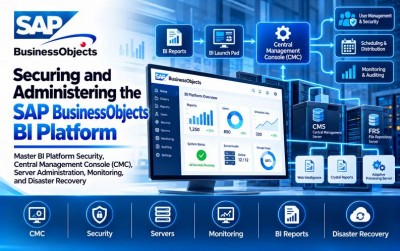
Securing and Administering the SAP BusinessObjects BI Platform is an advanced technical course designed for SAP BusinessObjects administrators, BI consultants, SAP Basis professionals, system administrators, BI architects, support engineers, and SAP certification candidates.
This learning journey provides a comprehensive understanding of securing SAP BusinessObjects BI Platform, administering BI content, implementing application security, managing Central Management Console (CMC), administering servers and services, monitoring platform performance, promoting BI content, and implementing disaster recovery strategies.
By completing this course, learners will gain practical expertise in BI platform security, content management, server administration, auditing, monitoring, deployment, and enterprise BI infrastructure management.
SAP BusinessObjects BI Platform is a comprehensive Business Intelligence platform that enables organizations to securely deliver reports, dashboards, analytics, and business insights across the enterprise. Proper administration and security are essential to maintaining reliable BI operations while protecting sensitive business information.
This course introduces SAP BusinessObjects BI Platform architecture, BI content administration, application security, server administration, monitoring, auditing, scheduling, promotion management, and disaster recovery planning. Participants will learn how to administer enterprise BI environments using the Central Management Console (CMC), BI Launch Pad, and supporting administrative tools.
The course also covers server management, web application administration, File Repository Servers (FRS), Adaptive Processing Server, Web Intelligence services, Crystal Reports services, BI Admin Studio, server groups, and enterprise deployment strategies.
Securing enterprise Business Intelligence content is one of the most critical responsibilities of a SAP BusinessObjects BI Platform administrator. Organizations must ensure that reports, dashboards, and analytical content are accessible only to authorized users while maintaining performance, compliance, and governance.
This module introduces SAP BusinessObjects BI Platform administration from a security perspective. Learners will understand BI content organization, Central Management Console (CMC), BI Launch Pad administration, object security, application security, scheduling, and secure content distribution across enterprise environments.
This unit introduces SAP BusinessObjects BI Platform, its architecture, components, administrative tools, and enterprise Business Intelligence capabilities. Learners will understand how the platform delivers secure reporting and analytics across organizations.
This unit explains how administrators organize, manage, and maintain BI content using the BI Launch Pad and Central Management Console (CMC). Learners will understand folder structures, object management, report organization, and administrative best practices.
This unit focuses on implementing security for reports, folders, and business objects using the Central Management Console. Learners will configure object-level permissions, access rights, inheritance, and security policies to protect enterprise BI content.
This unit introduces application-level security within SAP BusinessObjects BI Platform. Learners will configure authentication, authorization, application rights, and security models to ensure secure access to BI applications.
This unit explains how BI reports and business content are scheduled, published, and securely distributed to users. Learners will configure report scheduling, publication destinations, and enterprise content delivery mechanisms.
Reliable Business Intelligence platforms require properly configured servers, services, and infrastructure components. SAP BusinessObjects BI Platform provides centralized server management capabilities that enable administrators to maintain high availability, scalability, performance, and operational reliability.
This module focuses on SAP BusinessObjects server architecture, installation options, server administration, web application management, Central Management Server (CMS), File Repository Servers (FRS), scheduling servers, Adaptive Processing Server, Web Intelligence services, Crystal Reports services, BI Admin Studio, Promotion Management, server groups, and disaster recovery planning.
This unit introduces the technical architecture of SAP BusinessObjects BI Platform. Learners will understand platform components, server roles, deployment models, terminology, and enterprise BI infrastructure.
This unit explains the installation options available for SAP BusinessObjects BI Platform, helping administrators choose deployment models that best suit enterprise scalability, performance, and availability requirements.
This unit introduces the essential administrative tasks required to maintain a healthy SAP BusinessObjects BI Platform environment. Learners will understand server configuration, service management, user administration, platform maintenance, and routine operational activities necessary for ensuring platform stability and performance.
This unit focuses on the Web Application Tier, which provides user access to SAP BusinessObjects applications. Learners will understand how to configure, manage, and optimize web applications while ensuring secure and reliable access for enterprise users.
This unit explains the responsibilities of the Central Management Server (CMS), the core component responsible for managing platform metadata, authentication, security, scheduling, and overall platform administration.
This unit introduces File Repository Servers (FRS), which store reports, program objects, and repository content within the SAP BusinessObjects BI Platform. Learners will understand repository configuration, storage management, backup strategies, and maintenance.
This unit focuses on scheduling services that automate report generation, publication, and distribution. Learners will configure scheduling servers, optimize workloads, and ensure reliable execution of enterprise reporting jobs.
This unit explains the role of the Adaptive Processing Server (APS), which hosts numerous BI platform services. Learners will understand service allocation, performance tuning, resource optimization, and operational management.
This unit introduces Web Intelligence services administration, enabling learners to configure reporting services, manage report processing, optimize performance, and support enterprise Business Intelligence operations.
This unit focuses on administering Crystal Reports services, including report processing, scheduling, rendering, and service optimization for enterprise reporting environments.
This unit introduces BI Admin Studio, providing administrators with centralized tools for monitoring, administration, diagnostics, and platform management. Learners will explore administration dashboards and operational monitoring features.
This unit explains how Server Groups improve scalability, workload balancing, and high availability by organizing platform services into logical administrative groups.
This unit focuses on Promotion Management, enabling administrators to migrate reports, universes, security settings, and other BI objects between development, testing, and production environments while maintaining consistency.
This unit explains disaster recovery planning for SAP BusinessObjects BI Platform. Learners will understand backup strategies, system restoration, redundancy planning, and business continuity best practices to minimize downtime during unexpected failures.
Throughout this course, learners will complete hands-on administrative exercises using SAP BusinessObjects BI Platform. These practical activities simulate real-world enterprise Business Intelligence administration, enabling learners to configure platform security, manage BI content, administer servers, monitor system performance, and implement business continuity strategies.
Participants will perform the following practical exercises:
In this enterprise project, learners will administer a complete SAP BusinessObjects BI Platform environment for a fictional multinational organization.
Participants will secure BI content, configure application security, administer enterprise servers, monitor platform performance, migrate reporting content, and implement disaster recovery strategies to ensure a secure, scalable, and highly available Business Intelligence environment.
Configure:
Implement:
Administer:
Configure:
Upon successful completion of this project, learners will be able to: