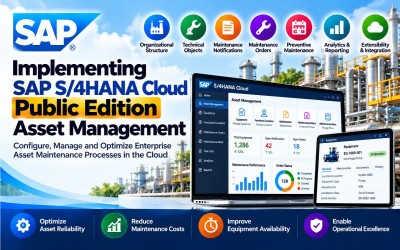
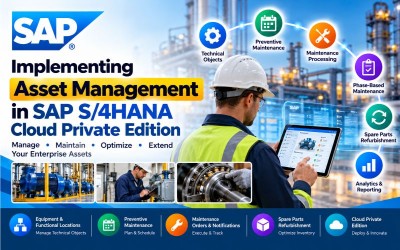
Implementing SAP S/4HANA Cloud Public Edition – Asset Management is a comprehensive enterprise training program designed for SAP Asset Management consultants, SAP S/4HANA Cloud consultants, maintenance planners, maintenance supervisors, plant managers, reliability engineers, implementation partners, ERP consultants, and business analysts who want to implement and manage asset maintenance processes using SAP S/4HANA Cloud Public Edition.
This course provides practical knowledge of SAP S/4HANA Cloud Public Edition Asset Management, including organizational structure, technical objects, maintenance planning, preventive maintenance, maintenance processing, maintenance execution, resource scheduling, maintenance notifications, work orders, analytics, integration, extensibility, and implementation best practices. Learners will gain hands-on experience implementing cloud-based enterprise asset management solutions following SAP Best Practices.
Following SAP's official Learning Journey, the course progresses from SAP Asset Management fundamentals through enterprise configuration, maintenance planning, execution, analytics, extensibility, and implementation using SAP S/4HANA Cloud Public Edition.
Efficient asset management is essential for maximizing equipment availability, reducing maintenance costs, improving operational reliability, and ensuring business continuity. SAP S/4HANA Cloud Public Edition – Asset Management enables organizations to manage maintenance operations through intelligent planning, preventive maintenance strategies, work order management, technical object management, and real-time analytics.
This course introduces the complete implementation lifecycle of SAP S/4HANA Cloud Public Edition Asset Management, including organizational structures, technical objects, maintenance notifications, maintenance orders, preventive maintenance, maintenance planning, scheduling, analytics, integration, extensibility, and cloud implementation best practices.
Throughout the course, learners will gain practical implementation experience while working through real-world maintenance scenarios across manufacturing, utilities, energy, oil & gas, transportation, healthcare, public sector, facilities management, and industrial enterprises.
By the end of this course, participants will possess the knowledge required to implement, configure, optimize, and support SAP S/4HANA Cloud Public Edition Asset Management solutions.
These roles are highly valued across manufacturing, utilities, oil & gas, mining, transportation, pharmaceuticals, healthcare, public sector, facilities management, and industrial organizations using SAP S/4HANA Cloud Public Edition.
This course is designed to support learners preparing for SAP S/4HANA Cloud Public Edition Asset Management certifications by covering the concepts included in SAP's official Learning Journey.
Participants will gain practical knowledge in:
The course combines conceptual learning with practical implementation exercises to prepare learners for enterprise SAP Asset Management projects and certification success.

SAP S/4HANA Cloud Public Edition Asset Management enables organizations to manage the complete lifecycle of physical assets through standardized maintenance processes, preventive maintenance strategies, technical object management, maintenance execution, and real-time analytics. It helps improve asset reliability, reduce downtime, optimize maintenance costs, and ensure operational excellence.
This module introduces the fundamentals of SAP Asset Management, organizational structures, technical objects, maintenance notifications, maintenance orders, and preventive maintenance processes within SAP S/4HANA Cloud Public Edition.
By the end of this module, learners will understand the foundation required to implement and manage enterprise asset maintenance processes.
According to the SAP Learning Journey, this module covers SAP Asset Management fundamentals, organizational structures, technical objects, maintenance processing, and preventive maintenance.
SAP Asset Management helps organizations manage maintenance activities throughout the lifecycle of physical assets. It enables maintenance teams to improve equipment reliability, optimize maintenance planning, reduce operational costs, and increase equipment availability through standardized enterprise maintenance processes.
Participants will gain an understanding of SAP Asset Management concepts and their role within SAP S/4HANA Cloud Public Edition.
Organizational structures define how maintenance activities are organized within SAP S/4HANA Cloud. Learners will configure maintenance plants, planning plants, work centers, maintenance planning groups, and other organizational elements required to support enterprise maintenance operations.
Technical Objects represent the physical assets maintained within SAP Asset Management. This unit explains how to configure and manage Equipment, Functional Locations, object hierarchies, asset structures, and master data used throughout maintenance operations.
Maintenance Notifications capture equipment issues, failures, inspection findings, service requests, and maintenance requirements. Notifications initiate maintenance activities and provide the information required for planning and execution.
Maintenance Orders organize and control maintenance work from planning through execution and completion. Learners will understand how maintenance orders support labor planning, material management, cost tracking, scheduling, confirmations, and maintenance completion.
Preventive Maintenance enables organizations to schedule recurring maintenance activities that reduce equipment failures and extend asset life. Learners will configure maintenance plans, maintenance strategies, task lists, scheduling parameters, and recurring maintenance programs.
Effective maintenance planning ensures that the required resources, materials, tools, labor, and documentation are available before maintenance work begins. SAP S/4HANA Cloud Public Edition enables planners to organize maintenance activities efficiently while minimizing equipment downtime and operational disruptions.
Participants will learn how to prepare maintenance work using planning functions, maintenance plans, task lists, and resource planning.
Maintenance scheduling ensures that maintenance activities are performed at the right time using available resources while minimizing production interruptions. Learners will configure maintenance schedules, prioritize work orders, and optimize maintenance execution.
Maintenance execution involves performing planned maintenance tasks, recording labor hours, consuming materials, updating equipment history, and completing maintenance activities according to approved work orders.
Participants will understand the complete maintenance execution process within SAP S/4HANA Cloud Public Edition.
Maintenance confirmations record completed work, actual labor hours, materials consumed, equipment status updates, and maintenance completion. Accurate confirmations improve maintenance history, reporting, and cost analysis.
Maintenance performance monitoring enables organizations to evaluate maintenance efficiency using key performance indicators (KPIs), equipment availability, work order completion rates, maintenance costs, and asset reliability metrics.
SAP S/4HANA Cloud Public Edition provides analytical applications, dashboards, and reports that enable maintenance managers to analyze maintenance performance, identify trends, monitor costs, and make data-driven maintenance decisions.
SAP S/4HANA Cloud Public Edition provides extensibility capabilities that allow organizations to adapt Asset Management applications to meet specific business requirements while maintaining a Clean Core architecture. Organizations can extend applications using key user extensibility, custom business objects, custom fields, business rules, analytics, and integration services without modifying standard SAP functionality.
This module introduces extensibility concepts, key user tools, custom fields, business logic extensions, analytics enhancements, integration capabilities, and cloud implementation best practices.
By the end of this module, learners will be able to extend SAP Asset Management applications while following SAP Best Practices and maintaining upgrade compatibility.
According to the SAP Learning Journey, this module covers extensibility, custom fields, key user tools, integration, and cloud implementation best practices.
SAP Extensibility enables organizations to adapt standard SAP applications to meet unique business requirements without modifying the SAP core. Learners will understand in-app extensibility, side-by-side extensibility, and cloud development approaches supported by SAP S/4HANA Cloud Public Edition.
Custom fields and business logic extensions allow organizations to capture additional business information, automate processes, and enhance standard SAP Asset Management functionality using key user extensibility tools.
Analytical applications provide maintenance managers and business users with actionable insights into asset performance, maintenance efficiency, equipment availability, maintenance costs, and operational KPIs. SAP S/4HANA Cloud Public Edition allows organizations to enhance analytical applications using custom fields, KPIs, filters, dashboards, and reporting capabilities while maintaining a Clean Core architecture.
Participants will learn how to configure and extend analytical applications to support enterprise maintenance decision-making.
SAP Asset Management integrates with other SAP S/4HANA Cloud modules and external enterprise applications to support seamless maintenance processes, procurement, inventory management, finance, production planning, and business reporting. This unit introduces standard integration scenarios and cloud communication technologies.
SAP Best Practices provide preconfigured business processes, implementation accelerators, and standardized workflows that reduce implementation effort and improve project success. Learners will understand how to apply SAP Best Practices while implementing Asset Management in SAP S/4HANA Cloud Public Edition.
Clean Core is a strategic implementation approach that minimizes modifications to standard SAP applications while allowing business-specific enhancements through supported extensibility options. Organizations adopting Clean Core benefit from simplified upgrades, lower maintenance costs, and faster adoption of SAP innovations.
Participants will learn how to apply Clean Core principles while extending SAP Asset Management applications.
Throughout this course, learners will complete practical exercises that simulate real-world SAP S/4HANA Cloud Public Edition Asset Management implementation and maintenance scenarios.
Participants will perform the following hands-on activities:
This capstone project enables learners to implement a complete SAP Asset Management solution for a multinational manufacturing organization using SAP S/4HANA Cloud Public Edition.
Participants will configure organizational structures, technical objects, preventive maintenance strategies, maintenance notifications, maintenance orders, planning and scheduling, analytics, integrations, extensibility, and Clean Core principles while following SAP Best Practices.
The implementation project follows the business processes and implementation methodology presented throughout the SAP Learning Journey.
A global manufacturing company operates multiple production facilities with thousands of critical assets, including production equipment, conveyor systems, utilities, power systems, and industrial machinery.
The organization wants to implement SAP S/4HANA Cloud Public Edition – Asset Management to improve maintenance planning, reduce unplanned downtime, increase equipment reliability, optimize maintenance costs, and standardize maintenance operations across all facilities.
The primary business objectives are to:
As the SAP Asset Management Functional Consultant, you are responsible for implementing and configuring the complete enterprise asset management solution while ensuring adherence to SAP Best Practices and Clean Core principles.
Configure:
Implement:
Configure:
Configure:
Implement:
Configure:
Complete:
Upon successful completion of this implementation project, learners will be able to: