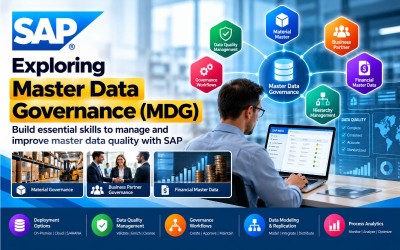
Exploring SAP Master Data Governance (MDG) is a comprehensive enterprise training program designed for SAP MDG consultants, SAP S/4HANA consultants, master data specialists, data governance managers, business analysts, ERP consultants, implementation partners, data stewards, and IT professionals who want to implement and manage SAP Master Data Governance across enterprise environments.
This course provides practical knowledge of SAP Master Data Governance (MDG), including MDG deployment models, governance processes, data domains, business partner governance, material governance, financial master data, hierarchy management, data quality management, mass processing, process analytics, data modeling, data replication, user experience, and SAP MDG customization. Learners will gain hands-on experience implementing SAP Master Data Governance while following SAP best practices.
Following SAP's official Learning Journey, the course progresses from MDG fundamentals through deployment strategies, governance processes, master data domains, configuration, data modeling, replication, and customization using SAP S/4HANA.
High-quality master data is essential for efficient business operations, regulatory compliance, analytics, and digital transformation. SAP Master Data Governance (MDG) enables organizations to create, govern, validate, distribute, and maintain trusted master data across multiple business domains while ensuring consistency throughout the enterprise.
This course introduces the complete implementation lifecycle of SAP Master Data Governance (MDG), including deployment options, governance processes, workflow management, data quality, business partner governance, material governance, financial master data governance, hierarchy management, process analytics, data replication, and customization.
Throughout the course, learners will gain practical implementation experience while following real-world enterprise master data governance scenarios across manufacturing, retail, finance, healthcare, logistics, utilities, telecommunications, and public sector organizations.
By the end of this course, participants will possess the knowledge required to implement, configure, customize, optimize, and support SAP Master Data Governance solutions using SAP S/4HANA.
These roles are highly valued across manufacturing, automotive, pharmaceuticals, retail, healthcare, banking, insurance, telecommunications, logistics, energy, utilities, government, and enterprises implementing SAP Master Data Governance.
This course is designed to support learners preparing for SAP Master Data Governance (MDG) and SAP S/4HANA certifications by covering the concepts included in SAP's official Learning Journey.
Participants will gain practical knowledge in:
The course combines conceptual learning with practical implementation scenarios to prepare learners for enterprise SAP Master Data Governance projects and certification success.

SAP Master Data Governance (MDG) enables organizations to establish trusted, accurate, and centrally governed master data across enterprise systems. Selecting the appropriate deployment strategy is essential for ensuring data consistency, regulatory compliance, and seamless integration across business processes.
This module introduces SAP Master Data Governance deployment options, SAP S/4HANA deployment, cloud deployment models, federated governance, and the business value of enterprise master data governance.
By the end of this module, learners will understand how to evaluate business requirements and select the most appropriate SAP MDG deployment approach.
According to the SAP Learning Journey, this module focuses on evaluating business scenarios and selecting appropriate SAP Master Data Governance deployment options.
SAP Master Data Governance (MDG) provides a centralized framework for creating, maintaining, validating, approving, and distributing high-quality master data across enterprise systems. It enables organizations to establish governance processes that improve data quality and business consistency.
Participants will learn the purpose, business value, architecture, and key capabilities of SAP Master Data Governance.
SAP Master Data Governance on SAP S/4HANA provides centralized governance capabilities directly within the SAP S/4HANA platform, enabling organizations to manage enterprise master data while integrating governance workflows with core ERP processes.
SAP offers cloud deployment options that provide flexible, scalable, and secure master data governance capabilities. Organizations can select deployment models based on business requirements, cloud strategy, scalability, and integration needs.
Federated Master Data Governance enables organizations to distribute governance responsibilities across multiple business units while maintaining centralized governance policies, standards, and enterprise-wide data consistency.
SAP Master Data Governance on SAP S/4HANA enables organizations to govern multiple master data domains through standardized governance workflows, validation rules, approval processes, data quality management, and enterprise-wide data consistency.
This module introduces SAP MDG solution strategy, governance processes, master data domains, mass processing, process analytics, cloud-ready capabilities, and enterprise data quality management.
By the end of this module, learners will be able to configure and manage SAP MDG business processes using SAP S/4HANA.
According to the SAP Learning Journey, this module prepares learners to understand the SAP MDG solution strategy, data domains, governance processes, and business processes within SAP MDG.
This unit introduces the SAP MDG solution strategy, governance architecture, business processes, and enterprise data governance concepts used to maintain trusted master data across organizations.
Material Master Governance enables organizations to create, validate, approve, maintain, and distribute material master records while ensuring data consistency across procurement, manufacturing, inventory, and sales operations.
Business Partner Governance centralizes the management of customers, suppliers, and business partners while maintaining consistent master data across finance, procurement, sales, and customer relationship management processes.
Financial Master Data Governance enables organizations to centrally manage financial master data while ensuring accuracy, consistency, compliance, and standardized governance processes across finance operations. Hierarchy Management supports the maintenance of enterprise structures and relationships used throughout business reporting and operational processes.
Participants will learn how SAP MDG governs financial master data and organizational hierarchies to improve enterprise-wide data quality and governance.
SAP MDG provides Mass Changes and Multiple Object Processing capabilities that enable organizations to update large volumes of master data efficiently while maintaining governance controls, workflow approvals, and data quality.
Mass Processing and Consolidation help organizations manage duplicate records, merge master data, standardize enterprise information, and improve overall data quality across multiple business systems.
Process Analytics provides visibility into governance workflows, approval cycles, processing efficiency, bottlenecks, and overall master data quality. Organizations can monitor governance performance using dashboards and key performance indicators.
Data Quality Management ensures that enterprise master data remains complete, accurate, standardized, and compliant with organizational policies. SAP MDG includes validation rules, duplicate checks, enrichment processes, and governance controls to maintain trusted data.
Cloud Ready Mode enables SAP Master Data Governance to support modern cloud-based enterprise environments while maintaining governance processes, scalability, integration capabilities, and operational flexibility.
SAP Master Data Governance on SAP S/4HANA enables organizations to configure governance models, extend standard content, build custom master data domains, improve data quality, and automate governance workflows. This module introduces data modeling, user experience, process modeling, data replication, and enterprise customization.
By the end of this module, learners will be able to configure and extend SAP Master Data Governance according to enterprise business requirements.
According to the SAP Learning Journey, this module prepares learners to perform basic configuration, extend standard MDG content, and create custom content.
This unit introduces SAP MDG architecture, governance framework, configuration approach, and implementation strategy required for enterprise master data governance projects.
SAP MDG provides advanced data quality enhancement capabilities that improve master data accuracy through validation, enrichment, duplicate detection, business rules, and governance workflows.
Data Modeling enables organizations to define master data structures, relationships, attributes, entity types, and governance models that align with enterprise business requirements.
SAP Master Data Governance provides an intuitive and role-based user experience that enables data stewards, business users, approvers, and administrators to efficiently manage master data through SAP Fiori applications and governance workflows. A streamlined user interface improves productivity, simplifies navigation, and accelerates data governance activities.
Participants will learn how SAP MDG delivers an efficient user experience for enterprise master data management.
Process Modeling enables organizations to design, configure, and optimize governance workflows for creating, approving, changing, and distributing master data. Well-designed workflows ensure standardized governance processes and regulatory compliance.
Data Replication enables trusted master data to be distributed across multiple SAP and non-SAP systems while maintaining consistency, synchronization, and enterprise-wide data integrity.
Participants will learn how SAP MDG supports centralized master data distribution across enterprise landscapes.
This unit introduces enterprise data transfer processes and hierarchy management techniques that support organizational structures, business reporting, and controlled master data distribution across integrated business systems.
SAP Master Data Governance Configuration and Customizing enables organizations to tailor SAP MDG according to enterprise business requirements by configuring governance frameworks, data models, workflows, validation rules, business rules, and master data processes.
This module introduces the configuration environment, MDG setup, customization activities, practice system usage, and implementation best practices.
By the end of this module, learners will be able to configure and customize SAP Master Data Governance solutions using SAP S/4HANA.
According to the SAP Learning Journey, this module provides a practice environment for SAP Master Data Governance Configuration and Customizing, including MDG setup and data modeling activities.
This unit introduces the initial setup and configuration of SAP Master Data Governance, including governance framework configuration, system preparation, organizational settings, and implementation best practices required for successful enterprise deployments.
Data Modeling within SAP MDG enables organizations to extend standard master data models or create custom governance objects that align with enterprise-specific business requirements while maintaining governance standards and data consistency.
Throughout this course, learners will complete hands-on exercises that simulate real-world SAP Master Data Governance implementation scenarios using SAP S/4HANA.
Participants will perform the following activities:
This capstone project provides learners with the opportunity to implement a complete SAP Master Data Governance solution for a multinational enterprise.
Participants will configure master data governance, establish governance workflows, implement material and business partner governance, improve data quality, configure data models, enable enterprise-wide data replication, and customize SAP MDG while following SAP Best Practices.
The implementation project follows the business processes and learning path covered throughout the SAP Learning Journey.
A multinational enterprise operates manufacturing plants, distribution centers, sales organizations, procurement departments, and finance teams across multiple countries. Due to inconsistent master data, duplicate records, poor data quality, and decentralized governance processes, the organization has decided to implement SAP Master Data Governance (MDG) on SAP S/4HANA.
The primary business objectives are to:
As the SAP Master Data Governance (MDG) Functional Consultant, you are responsible for implementing an enterprise-wide master data governance solution while following SAP Best Practices and governance standards.
Configure:
Implement:
Configure:
Implement:
Configure:
Configure:
Complete: