Course description

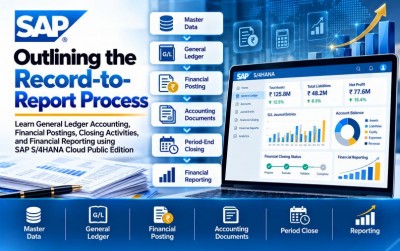
Outlining the Record-to-Report Process is a comprehensive SAP S/4HANA Cloud Public Edition training program designed for finance professionals, SAP Financial Accounting (FI) consultants, ERP implementation teams, accountants, business users, and SAP certification candidates who want to understand and execute the complete Record-to-Report (R2R) process.

This course provides practical knowledge of Financial Accounting master data, General Ledger (G/L) accounting, organizational structures, financial postings, posting scenarios, accounting documents, reporting, month-end and year-end closing activities, and financial statement preparation.

Learners will gain hands-on understanding of how financial transactions flow through SAP S/4HANA Cloud, from master data creation to General Ledger postings, financial reporting, and period-end closing.

The course prepares participants to confidently participate in SAP S/4HANA Cloud Public Edition implementation projects with a specialization in Financial Accounting and the Record-to-Report business process.

The Record-to-Report (R2R) process is one of the most critical business processes within SAP Financial Accounting. It enables organizations to capture financial transactions, maintain accounting records, perform financial closing activities, and generate accurate financial statements for management and statutory reporting.

This course introduces the complete Record-to-Report lifecycle, beginning with Financial Accounting master data, organizational structures, and General Ledger concepts before progressing into financial postings, posting scenarios, accounting documents, financial reporting, and local closing activities.

Learners will understand how SAP S/4HANA Cloud Public Edition integrates Financial Accounting processes to ensure financial accuracy, regulatory compliance, and enterprise reporting.

By the end of this course, participants will possess the practical knowledge required to understand and support Record-to-Report processes using SAP S/4HANA Cloud Public Edition.

Who Should Attend

  • SAP FI Consultants
  • SAP S/4HANA Cloud Consultants
  • Finance Professionals
  • General Ledger Accountants
  • Financial Controllers
  • ERP Consultants
  • Business Analysts
  • Finance Managers
  • Chartered Accountants
  • Internal Auditors
  • Financial Reporting Specialists
  • SAP Functional Consultants
  • ERP Implementation Teams
  • Business Process Owners
  • SAP Certification Candidates

Skills You Will Gain

  • Record-to-Report (R2R)
  • SAP Financial Accounting
  • SAP S/4HANA Cloud Public Edition
  • General Ledger Accounting
  • Chart of Accounts
  • Company Code Configuration
  • Controlling Area
  • G/L Account Maintenance
  • Financial Posting
  • Posting Keys
  • Accounting Documents
  • Document Types
  • Manual Clearing
  • Financial Reporting
  • Parallel Accounting
  • Segment Accounting
  • Cost of Sales Reporting
  • Month-End Closing
  • Year-End Closing
  • Financial Statement Preparation

Career Opportunities

  • SAP FI Consultant
  • SAP Financial Accounting Consultant
  • SAP S/4HANA Cloud Consultant
  • General Ledger Accountant
  • Financial Controller
  • Finance Business Analyst
  • ERP Functional Consultant
  • Financial Reporting Specialist
  • Finance Manager
  • Internal Auditor
  • SAP Functional Analyst
  • Accounting Systems Consultant
  • ERP Implementation Consultant
  • Business Process Consultant
  • SAP Financial Analyst

Certification Preparation

What will i learn?

  • Understand the Record-to-Report process.
  • Explain Financial Accounting master data.
  • Configure organizational structures.
  • Manage General Ledger master data.
  • Perform General Ledger postings.
  • Understand posting keys and document types.
  • Execute various posting procedures.
  • Analyze accounting documents.
  • Understand parallel accounting.
  • Explain segment accounting.
  • Perform month-end and year-end closing.
  • Execute General Ledger closing activities.
  • Generate financial reports.
  • Support SAP Record-to-Report implementation projects.

Requirements

  • Basic Accounting Principles
  • Financial Accounting Fundamentals
  • ERP Concepts
  • Basic SAP Navigation
  • Computer or Laptop
  • Internet Connection
  • SAP S/4HANA Cloud Public Edition Access (Recommended)
  • SAP Fiori Launchpad

Frequently asked question

Yes. The course begins with Financial Accounting fundamentals, organizational structures, and General Ledger concepts before progressing into postings, reporting, and closing activities.

Yes. You will learn Chart of Accounts, Company Code, Controlling Area, General Ledger master data, G/L account maintenance, and financial reporting.

Yes. The course explains posting keys, document types, document numbering, manual clearing, posting dates, document validation, and accounting document analysis.

Absolutely. Learners will understand Parallel Accounting, Segment Accounting, Cost of Sales Reporting, and their role in internal and external financial reporting.

Yes. The course covers posting periods, special posting periods, accruals, deferrals, automatic clearing, foreign currency valuation, balance carryforward, and financial statement versions.

Yes. Learners will analyze accounting data, maintain financial statement versions, and understand reporting capabilities available in SAP S/4HANA Cloud.

Yes. The course is designed for accountants, finance managers, controllers, SAP consultants, ERP professionals, and anyone involved in enterprise financial accounting processes.

Yes. This course follows the SAP Learning Journey and prepares learners for Financial Accounting and Record-to-Report topics within SAP S/4HANA Cloud Public Edition certification.

  • Lesson 01 00:00:00
    Module 1 Overview

    Master data is the foundation of every financial transaction in SAP S/4HANA Cloud Public Edition. Before organizations can record accounting entries, maintain financial records, or generate reports, they must establish a well-structured financial organizational framework and General Ledger master data.

    This module introduces the key master data objects used in the Record-to-Report (R2R) process, including the Chart of Accounts, Company Code, Controlling Area, General Ledger (G/L) Accounts, and other organizational elements used in Financial Accounting. Learners will also explore G/L account maintenance and reporting capabilities for monitoring master data changes.

    By the end of this module, learners will understand how master data supports financial accounting, reporting, and enterprise financial management.

    What You Will Learn

    • Understand Financial Accounting organizational structures.
    • Explain the Chart of Accounts.
    • Configure Company Codes.
    • Understand Controlling Areas.
    • Maintain General Ledger accounts.
    • Configure G/L account settings.
    • Analyze G/L account changes.
    • Perform individual and mass maintenance.
    • Understand Financial Accounting organizational elements.

    Units in This Module

    • Unit 1.1: Explaining the Organizational Structure and G/L Account Master Data Maintenance
  • Lesson 02 00:00:00
    1.1 Explaining the Organizational Structure and G/L Account Master Data Maintenance

    This unit introduces the organizational framework used in SAP Financial Accounting and explains how General Ledger master data is structured and maintained. Learners will understand the relationship between the Chart of Accounts, Company Code, Controlling Area, and General Ledger Accounts while learning how these elements support enterprise financial reporting.

    Key Topics

    • Chart of Accounts
    • Company Code
    • Controlling Area
    • General Ledger Accounts
    • G/L Master Data
    • Organizational Structure
    • Master Data Maintenance
    • Financial Reporting

  • Lesson 01 00:00:00
    Module 2 Overview

    Financial postings are at the core of the Record-to-Report process. Every accounting transaction recorded in SAP S/4HANA Cloud Public Edition follows standardized posting rules that ensure financial accuracy, auditability, and regulatory compliance.

    This module introduces General Ledger document posting concepts, accounting documents, document types, posting keys, document numbering, posting periods, manual clearing, document validation, and financial reporting basics.

    By the end of this module, learners will understand how financial transactions are recorded and managed throughout the Record-to-Report process.

    What You Will Learn

    • Understand General Ledger postings.
    • Explain accounting documents.
    • Configure document types.
    • Understand posting keys.
    • Manage document numbering.
    • Perform manual clearing.
    • Hold and validate documents.
    • Manage posting periods.
    • Analyze accounting reports.

    Units in This Module

    • Unit 2.1: Identifying the Basic Concepts of Financial Postings and Documents
    • Unit 2.2: Identifying Key Elements Required for Posting General Ledger Documents
    • Unit 2.3: Performing Different Posting Procedures
    • Unit 2.4: Analyzing and Reporting Accounting Data
  • Lesson 02 00:00:00
    2.1 Identifying the Basic Concepts of Financial Postings and Documents

    This unit introduces the basic principles of financial postings, accounting documents, and General Ledger transactions. Learners will understand how accounting documents are created and how financial transactions are recorded within SAP.

    Key Topics

    • Financial Posting
    • Accounting Documents
    • General Ledger
    • Posting Logic
    • Journal Entries
    • SAP Financial Accounting
    • Transaction Recording
    • Financial Documents
  • Lesson 03 00:00:00
    2.2 Identifying Key Elements Required for Posting General Ledger Documents

    Learners will explore the essential elements required for General Ledger postings, including document types, posting keys, document numbering, posting dates, fiscal periods, and account determination.

    Key Topics

    • Document Types
    • Posting Keys
    • Document Numbering
    • Posting Dates
    • Fiscal Periods
    • Account Determination
    • G/L Posting
    • Financial Transactions
  • Lesson 04 00:00:00
    2.3 Performing Different Posting Procedures

    This unit focuses on various posting procedures such as manual postings, document holding, validation, reversing documents, and manual clearing processes used in enterprise accounting.

    Key Topics

    • Manual Posting
    • Document Holding
    • Document Validation
    • Document Reversal
    • Manual Clearing
    • Financial Transactions
    • Accounting Controls
    • SAP Posting Procedures
  • Lesson 05 00:00:00
    2.4 Analyzing and Reporting Accounting Data

    Learners will understand how accounting data is analyzed using SAP reporting tools. The unit explains account analysis, financial reporting basics, multidimensional reporting, and financial data evaluation.

    Key Topics

    • Financial Reporting
    • Account Analysis
    • General Ledger Reports
    • Financial Analytics
    • SAP Reporting
    • Accounting Data
    • Reporting Dimensions
    • Financial Insights

  • Lesson 01 00:00:00
    Module 3 Overview

    Financial transactions in an organization are recorded differently depending on internal management requirements, statutory regulations, and external reporting standards. SAP S/4HANA Cloud Public Edition supports multiple accounting approaches that enable organizations to satisfy both internal management reporting and external financial reporting requirements.

    This module introduces the major posting scenarios used within the Record-to-Report (R2R) process, including Parallel Accounting, Segment Accounting, and Cost of Sales Reporting. Learners will understand how different posting scenarios support regulatory compliance, management reporting, and financial analysis.

    By the end of this module, learners will understand how SAP S/4HANA Cloud Public Edition manages various financial posting scenarios to meet enterprise reporting requirements.

    What You Will Learn

    • Understand posting scenarios in Financial Accounting.
    • Explain Parallel Accounting.
    • Understand Segment Accounting.
    • Explain Cost of Sales Reporting.
    • Differentiate internal and external reporting.
    • Understand statutory reporting requirements.
    • Support enterprise financial reporting.
    • Analyze accounting structures.
    • Prepare for advanced Financial Accounting topics.

    Units in This Module

    • Unit 3.1: Describing Postings to Meet Internal and External Reporting Requirements
  • Lesson 02 00:00:00
    3.1 Describing Postings to Meet Internal and External Reporting Requirements

    This unit explains how SAP S/4HANA Cloud Public Edition supports different accounting requirements using Parallel Accounting, Segment Accounting, and Cost of Sales Reporting. Learners will understand how organizations prepare financial information for both internal management and external statutory reporting.

    Key Topics

    • Parallel Accounting
    • Segment Accounting
    • Cost of Sales Reporting
    • Internal Reporting
    • External Reporting
    • Financial Statements
    • Management Reporting
    • SAP Financial Accounting

  • Lesson 01 00:00:00
    Module 4 Overview

    Period-end closing is one of the most important activities in the Record-to-Report process. It ensures that financial transactions are complete, reconciled, and accurately reflected in financial statements before month-end and year-end reporting.

    This module introduces the local closing process for General Ledger Accounting, including posting period management, special posting periods, accruals, deferrals, automatic clearing, foreign currency valuation, balance carryforward, and financial statement version maintenance.

    By the end of this module, learners will be able to understand and support General Ledger closing activities using SAP S/4HANA Cloud Public Edition.

    What You Will Learn

    • Manage posting periods.
    • Configure special posting periods.
    • Understand accruals and deferrals.
    • Execute automatic clearing.
    • Perform foreign currency valuation.
    • Execute balance carryforward.
    • Maintain financial statement versions.
    • Understand month-end closing.
    • Understand year-end closing.

    Units in This Module

    • Unit 4.1: Describing the Local Close Steps for General Ledger Accounting
  • Lesson 02 00:00:00
    4.1 Describing the Local Close Steps for General Ledger Accounting

    This unit explains the complete General Ledger local closing process used during month-end and year-end financial closing. Learners will understand posting period control, accruals, automatic clearing, foreign currency revaluation, balance carryforward, and financial statement preparation.

    Key Topics

    • Posting Periods
    • Special Posting Periods
    • Accruals
    • Deferrals
    • Automatic Clearing
    • Foreign Currency Valuation
    • Balance Carryforward
    • Financial Statement Version
    • Month-End Closing
    • Year-End Closing

  • Lesson 01 00:00:00
    Practical Exercises

    Throughout this course, learners will complete hands-on implementation exercises using SAP S/4HANA Cloud Public Edition – Record-to-Report (R2R).

    Participants will perform the following practical exercises:

    • Configure the Chart of Accounts.
    • Create and maintain General Ledger accounts.
    • Configure Company Codes and Controlling Areas.
    • Maintain G/L master data.
    • Analyze G/L account changes.
    • Perform individual and mass G/L account maintenance.
    • Post General Ledger documents.
    • Configure document types and posting keys.
    • Execute manual postings and document reversals.
    • Manage posting periods.
    • Perform manual clearing.
    • Analyze accounting documents.
    • Generate General Ledger reports.
    • Configure Parallel Accounting.
    • Configure Segment Accounting.
    • Understand Cost of Sales Reporting.
    • Execute month-end closing activities.
    • Configure accruals and deferrals.
    • Perform automatic clearing.
    • Execute foreign currency valuation.
    • Run balance carryforward.
    • Maintain financial statement versions.
    • Prepare General Ledger reports for financial closing.
  • Lesson 02 00:00:00
    Enterprise Capstone Project

    Implementing the Record-to-Report (R2R) Process in SAP S/4HANA Cloud Public Edition

    In this capstone project, learners will implement a complete Record-to-Report (R2R) solution for a fictional enterprise using SAP S/4HANA Cloud Public Edition.

    The project simulates a real-world SAP Financial Accounting implementation where learners configure Financial Accounting organizational structures, General Ledger master data, perform financial postings, execute posting scenarios, complete period-end closing activities, and generate financial reports.

    Phase 1 – Financial Accounting Foundation

    Configure:

    • Chart of Accounts
    • General Ledger Accounts
    • Company Code
    • Controlling Area
    • Financial Accounting Organizational Structure
    • G/L Account Master Data
    • Organizational Assignments
    • Master Data Reporting

    Phase 2 – General Ledger Posting Configuration

    Implement:

    • General Ledger Document Posting
    • Document Types
    • Posting Keys
    • Document Number Ranges
    • Posting Dates
    • Posting Period Management
    • Manual Clearing
    • Document Holding
    • Document Validation
    • Financial Posting Reports

    Phase 3 – Advanced Financial Posting Scenarios

    Configure:

    • Parallel Accounting
    • Segment Accounting
    • Cost of Sales Reporting
    • Internal Reporting
    • External Reporting
    • Financial Statement Reporting
    • Accounting Analysis
    • Enterprise Financial Reporting

    Phase 4 – General Ledger Closing Activities

    Configure:

    • Posting Period Intervals
    • Special Posting Periods
    • Accruals
    • Deferrals
    • Automatic Clearing
    • Foreign Currency Valuation
    • Balance Carryforward
    • Financial Statement Version
    • Month-End Closing
    • Year-End Closing

    Expected Project Outcome

    Upon successful completion of the capstone project, learners will be able to:

    • Configure Financial Accounting organizational structures.
    • Create and maintain General Ledger accounts.
    • Configure Chart of Accounts.
    • Configure Company Codes.
    • Maintain Controlling Areas.
    • Perform General Ledger postings.
    • Configure document types and posting keys.
    • Execute manual clearing.
    • Analyze accounting documents.
    • Configure Parallel Accounting.
    • Configure Segment Accounting.
    • Perform Cost of Sales Reporting.
    • Execute month-end and year-end closing.
    • Perform foreign currency valuation.
    • Maintain financial statement versions.
    • Generate enterprise financial reports.
    • Support SAP Record-to-Report implementation projects.

Jittesh Purrohit

Lectures

13

Skill level

Intermediate

Expiry period

Lifetime

Related courses