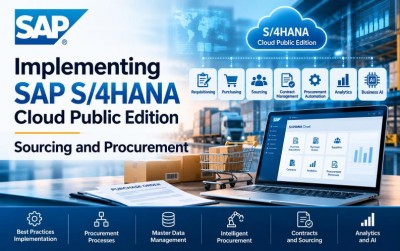
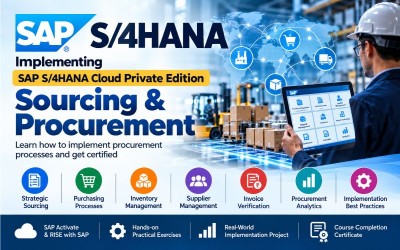
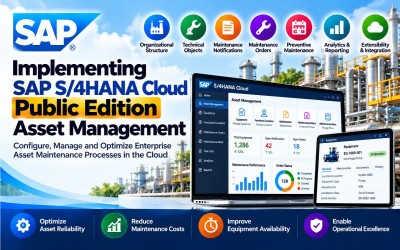
Implementing SAP S/4HANA Cloud Public Edition – Sourcing and Procurement is a comprehensive implementation training program designed for SAP consultants, procurement professionals, sourcing specialists, purchasing managers, supply chain consultants, ERP implementation teams, and SAP certification candidates.
This course provides complete knowledge of implementing procurement processes in SAP S/4HANA Cloud Public Edition, beginning with the SAP implementation lifecycle and progressing through procurement master data, requisitioning, purchasing, sourcing, procurement automation, intelligent procurement, service procurement, contract management, subcontracting, supplier consignment, procurement APIs, and Business AI.
Learners will gain hands-on experience configuring procurement business processes using SAP Central Business Configuration (CBC), SAP Fiori Launchpad, Business AI, Flexible Workflows, and Procurement Analytics, enabling them to participate confidently in enterprise SAP Sourcing & Procurement implementation projects.
Procurement plays a vital role in every enterprise by ensuring that materials and services are sourced efficiently while maintaining supplier relationships, controlling costs, and supporting business continuity.
This course introduces the complete implementation lifecycle of SAP S/4HANA Cloud Public Edition – Sourcing and Procurement, covering organizational structures, procurement master data, requisitioning, consumable purchasing, direct material procurement, procurement automation, intelligent procurement, service purchasing, sourcing and contract management, subcontracting, supplier consignment, procurement APIs, and artificial intelligence.
Learners will also understand how SAP Business AI, procurement analytics, flexible workflows, and cloud integrations improve procurement efficiency and decision-making.
By the end of this course, participants will be able to implement enterprise procurement processes using SAP best practices while preparing for SAP S/4HANA Cloud Public Edition certification. This structure is based on the uploaded SAP Learning Journey.
Implementing SAP S/4HANA Cloud Public Edition requires a structured implementation methodology that covers project preparation, system landscapes, business process configuration, security, integrations, migration, extensibility, and testing.
This module introduces the complete implementation lifecycle using SAP implementation best practices. Learners will build implementation teams, define cloud system landscapes, configure business processes using SAP Central Business Configuration (CBC), work with SAP Fiori Launchpad, configure authorizations, migrate business data, and validate configured business processes before deployment.
By the end of this module, learners will understand the complete SAP S/4HANA Cloud Public Edition implementation methodology.
This unit introduces SAP S/4HANA Cloud Public Edition, cloud ERP architecture, SAP Best Practices, deployment methodology, cloud implementation lifecycle, and enterprise digital transformation.
Learners will understand implementation project roles, governance, stakeholder responsibilities, project planning, SAP Activate methodology, and collaboration between business and technical teams.
This unit explains SAP Cloud system landscapes, development, testing, quality assurance, production environments, tenants, and deployment strategies used during SAP implementation projects.
Participants will configure business users, business roles, identity management, authorization concepts, and cloud security required for SAP S/4HANA Cloud implementations.
Fit-to-Standard workshops align enterprise business requirements with SAP Best Practices. Learners will conduct workshops, validate business scenarios, document requirements, and perform gap analysis.
This unit introduces SAP Central Business Configuration (CBC), enabling consultants to configure organizational structures, enterprise processes, and implementation activities following SAP Best Practices.
Learners will explore SAP Fiori Launchpad, role-based applications, business catalogs, spaces, pages, navigation, and personalized user experiences.
Participants will configure authorization objects, business catalogs, user permissions, access management, and secure business process execution.
Learners will customize SAP applications using custom fields, custom logic, UI adaptation, extensibility tools, and Clean Core principles.
This unit explains enterprise integrations, APIs, communication arrangements, cloud connectivity, and integration scenarios within SAP S/4HANA Cloud.
Participants will learn migration planning, migration objects, master data migration, transactional data migration, validation, and SAP Migration Cockpit.
Learners will understand business process testing, automation, user acceptance testing, defect management, quality assurance, and production readiness.
A successful procurement implementation begins with understanding the sourcing and procurement lifecycle and the organizational structures that support purchasing activities. SAP S/4HANA Cloud Public Edition provides a standardized procurement framework that enables organizations to manage suppliers, purchasing organizations, plants, company codes, purchasing groups, and procurement business processes efficiently.
This module introduces the fundamentals of SAP S/4HANA Cloud Public Edition Sourcing and Procurement, including procurement concepts, procurement process flow, organizational structure, and the relationships between purchasing organizations and enterprise business units.
By the end of this module, learners will understand how procurement is structured within SAP S/4HANA Cloud Public Edition and how organizational elements work together to support enterprise purchasing operations.
This unit introduces the sourcing and procurement solution in SAP S/4HANA Cloud Public Edition. Learners will understand procurement concepts, purchasing lifecycle, supplier collaboration, procurement processes, and SAP Best Practices that support enterprise purchasing operations.
Organizational structures define how procurement activities are managed within an enterprise. Learners will understand Company Codes, Plants, Purchasing Organizations, Purchasing Groups, Storage Locations, and their relationships within SAP S/4HANA Cloud Public Edition.
Master Data forms the foundation of every procurement process in SAP S/4HANA Cloud Public Edition. Accurate and well-maintained master data enables efficient purchasing, supplier management, inventory control, pricing, valuation, and procurement reporting.
This module introduces procurement master data, including Business Partners, Product Master Data, Purchasing Info Records, Posting Period Management, and Material Valuation. Learners will understand how master data supports procurement operations and enterprise purchasing activities.
By the end of this module, participants will be able to maintain procurement master data required for efficient sourcing and purchasing processes.
Master data ensures consistency across procurement processes. Learners will maintain Business Partner records, Product Master Data, Purchasing Info Records, posting periods, and material valuation while supporting enterprise procurement activities.
Requisitioning is the first operational step in the procurement lifecycle and enables employees to request goods and services required for business operations. SAP S/4HANA Cloud Public Edition supports self-service procurement, catalog-based purchasing, and standardized purchase requisition processing.
This module introduces requisitioning processes, including self-service procurement, catalog management, purchase requisitions, and user default settings that improve purchasing efficiency and procurement governance.
By the end of this module, learners will understand how requisitioning supports enterprise procurement workflows and purchasing operations.
This unit explains the requisitioning process in SAP S/4HANA Cloud Public Edition. Learners will create purchase requisitions, use procurement catalogs, configure user preferences, and support self-service procurement within enterprise purchasing environments.
Consumable Purchasing manages the procurement of goods that are consumed during business operations rather than stored as inventory. SAP S/4HANA Cloud Public Edition provides efficient processes for requesting, purchasing, receiving, and accounting for consumable materials.
This module introduces consumable purchasing processes, purchase requisitions, purchase orders, goods receipt, invoice verification, and procurement activities for non-stock materials.
By the end of this module, learners will understand how to manage consumable purchasing efficiently while following SAP procurement best practices.
This unit introduces the complete consumable purchasing process, including purchase requisition creation, purchase order processing, goods receipt, invoice verification, and procurement activities for consumable materials.
Direct materials are essential components used in manufacturing and production processes. Efficient procurement of these materials ensures uninterrupted production, optimized inventory levels, and effective supplier collaboration. SAP S/4HANA Cloud Public Edition provides integrated processes for planning, purchasing, receiving, and managing direct materials throughout the procurement lifecycle.
This module introduces the procurement process for direct materials, including purchase requisitions, purchase orders, goods receipts, invoice processing, procurement monitoring, and integration with Material Requirements Planning (MRP).
By the end of this module, learners will understand how direct material procurement supports manufacturing operations and enterprise supply chain management.
This unit explains the complete procurement cycle for direct materials used in production. Learners will understand procurement planning, purchase requisition processing, purchase order creation, goods receipt, invoice verification, and supplier collaboration.
Procurement automation enables organizations to reduce manual effort, improve purchasing efficiency, and automate repetitive procurement activities. SAP S/4HANA Cloud Public Edition offers intelligent automation capabilities such as Material Requirements Planning (MRP), automatic purchase order creation, evaluated receipt settlement, flexible workflows, and procurement analytics.
This module introduces procurement automation features that streamline purchasing operations while improving accuracy, compliance, and operational efficiency.
By the end of this module, learners will understand how SAP automates procurement processes using built-in intelligent business capabilities.
Material Requirements Planning (MRP) ensures that materials are available for production while maintaining optimal inventory levels. Learners will configure MRP, monitor planning proposals, and understand procurement planning strategies.
Automation improves procurement efficiency by reducing manual purchasing activities. Learners will configure automated procurement processes, automatic purchase order generation, approval workflows, and procurement monitoring.
Procurement Analytics enables organizations to monitor procurement performance through dashboards, KPIs, operational reports, and purchasing insights. Learners will analyze procurement data and improve purchasing decisions using embedded analytics.
Artificial Intelligence (AI) is transforming procurement by improving decision-making, automating repetitive tasks, and providing intelligent recommendations. SAP Business AI enhances procurement processes through predictive analytics, intelligent document processing, supplier recommendations, and automated procurement insights.
This module introduces SAP Business AI capabilities available within SAP S/4HANA Cloud Public Edition and explains how AI supports procurement professionals in enterprise purchasing environments.
By the end of this module, learners will understand how Business AI improves procurement efficiency, supplier collaboration, and operational decision-making.
This unit introduces Business AI features integrated within SAP S/4HANA Cloud Public Edition. Learners will explore AI-driven procurement recommendations, intelligent automation, predictive insights, and AI-assisted procurement activities.
Service Procurement enables organizations to efficiently procure, manage, and monitor services provided by external vendors. SAP S/4HANA Cloud Public Edition supports service procurement through structured procurement processes, service entry sheets, purchase orders, approval workflows, and invoice verification.
This module introduces the complete service procurement lifecycle, including service master data, procurement documents, service confirmations, service entry sheets, invoice processing, and procurement monitoring.
By the end of this module, learners will understand how to configure and execute service procurement processes that ensure transparency, compliance, and efficient service management across the enterprise.
This unit explains how organizations procure services from external vendors using SAP S/4HANA Cloud Public Edition. Learners will create service purchase orders, manage service entry sheets, process supplier invoices, and monitor service procurement activities.
Strategic sourcing and contract management enable organizations to establish long-term supplier relationships, negotiate favorable purchasing terms, and improve procurement efficiency. SAP S/4HANA Cloud Public Edition provides integrated capabilities for sourcing, requests for quotation, purchase contracts, scheduling agreements, and supplier collaboration.
This module introduces sourcing activities, supplier evaluation, contract management, purchasing agreements, and procurement planning to support enterprise procurement strategies.
By the end of this module, learners will understand how sourcing and contract management optimize purchasing operations and supplier performance.
Operational sourcing focuses on selecting suppliers, requesting quotations, comparing supplier responses, and awarding procurement opportunities. Learners will understand the operational sourcing process and supplier collaboration.
Purchase contracts and scheduling agreements provide long-term procurement arrangements with suppliers. Learners will create contracts, maintain scheduling agreements, monitor contract consumption, and optimize purchasing efficiency.
Advanced procurement processes support complex procurement scenarios commonly used in manufacturing and supply chain operations. SAP S/4HANA Cloud Public Edition provides specialized procurement methods such as subcontracting and supplier consignment to improve inventory management, supplier collaboration, and production efficiency.
This module introduces advanced procurement scenarios and explains how organizations configure and execute subcontracting and supplier consignment processes.
By the end of this module, learners will understand how advanced procurement supports efficient manufacturing and supply chain operations.
Subcontracting enables organizations to send raw materials to external suppliers for processing while maintaining ownership of the supplied materials. Learners will understand subcontracting procurement, material movements, and supplier collaboration.
Supplier Consignment allows organizations to store supplier-owned inventory at their premises while paying only when materials are consumed. Learners will understand consignment stock management, procurement processes, and inventory ownership.
Modern enterprise procurement requires seamless integration between SAP systems and external applications. SAP S/4HANA Cloud Public Edition provides APIs and communication management capabilities that enable secure data exchange, system integration, automation, and digital procurement.
This module introduces procurement APIs, communication arrangements, integration scenarios, and external connectivity that support enterprise procurement ecosystems.
By the end of this module, learners will understand how SAP Procurement APIs facilitate integration with third-party systems and cloud applications.
This unit introduces procurement APIs and communication management within SAP S/4HANA Cloud Public Edition. Learners will configure communication scenarios, API authentication, data exchange, and enterprise integrations.
Procurement Analytics enables organizations to measure procurement performance, monitor supplier activities, evaluate purchasing trends, and support data-driven decision-making. SAP S/4HANA Cloud Public Edition provides embedded analytics, dashboards, KPIs, and procurement reports that improve procurement visibility and operational excellence.
This module introduces procurement analytics, embedded reporting, operational dashboards, key performance indicators, and business insights for enterprise procurement.
By the end of this module, learners will understand how procurement analytics supports strategic purchasing decisions and continuous procurement improvement.
This unit introduces procurement analytics capabilities within SAP S/4HANA Cloud Public Edition. Learners will use embedded analytics, dashboards, KPIs, procurement reports, and operational insights to monitor and optimize procurement performance.
Throughout this course, learners will complete hands-on implementation exercises using SAP S/4HANA Cloud Public Edition – Sourcing and Procurement. These practical labs are designed to simulate real-world procurement implementation scenarios and reinforce configuration skills through guided activities.
Participants will perform the following practical exercises:
In this capstone project, learners will implement a complete enterprise procurement solution for a fictional global manufacturing organization using SAP S/4HANA Cloud Public Edition.
The project simulates a real SAP implementation where learners configure procurement organizational structures, master data, purchasing processes, sourcing activities, procurement automation, service procurement, supplier collaboration, procurement analytics, and cloud integrations.
Configure:
Configure:
Implement:
Configure:
Implement:
Configure:
Upon successful completion of the capstone project, learners will be able to: