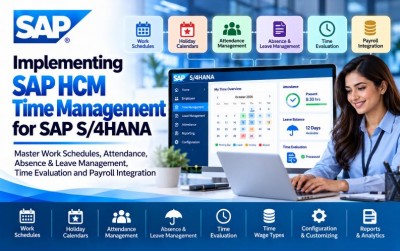
Implementing SAP HCM Time Management for SAP S/4HANA is a comprehensive professional training program designed for SAP HCM Consultants, Time Management Consultants, HR Professionals, Payroll Consultants, HRIS Administrators, SAP Functional Consultants, Solution Architects, Digital HR Consultants, and SAP certification candidates.
This learning journey provides complete coverage of SAP HCM Time Management within SAP S/4HANA, enabling learners to configure work schedules, manage attendance and absences, implement time recording, configure leave administration, execute time evaluation, integrate time management with payroll, and support enterprise workforce management processes.
Effective workforce time management is essential for ensuring accurate payroll, legal compliance, employee productivity, and efficient workforce planning.
In this course, learners will progress from SAP HCM Time Management fundamentals to advanced configuration. They will explore employee work schedules, holiday calendars, absence and attendance processing, substitutions, availability management, leave quotas, time recording methods, time evaluation, time wage types, overtime processing, and payroll integration.
By the end of this course, learners will be able to configure, administer, and support complete SAP HCM Time Management solutions for SAP S/4HANA enterprise environments.
This module introduces the core business processes of SAP HCM Time Management in SAP S/4HANA. Learners will understand workforce time management concepts, work schedules, attendance and absence management, leave administration, substitutions, availability, and integration with payroll and other SAP HCM components.
This unit introduces SAP HCM Time Management and explains its role in workforce scheduling, attendance recording, leave management, payroll integration, and enterprise HR operations. Learners will understand how time management supports workforce productivity and compliance.
This unit explains work schedule concepts, including daily work schedules, period work schedules, work schedule rules, and employee shift planning used to manage workforce availability.
This unit introduces holiday calendars, public holidays, factory calendars, and calendar assignments that influence employee attendance, leave management, and payroll calculations.
This unit explains attendance management, including attendance recording, attendance types, working hours, overtime eligibility, and attendance-related payroll integration.
This unit introduces absence management, enabling learners to configure employee leave, sickness, unpaid leave, and other absence categories while maintaining accurate workforce records.
This unit focuses on leave administration, including leave quotas, leave entitlement, leave requests, quota generation, and absence management policies.
This unit explains substitutions, employee availability, temporary schedule changes, and workforce planning scenarios required to support operational continuity.
This unit explains how attendance, absences, overtime, leave balances, and time wage types are transferred to SAP Payroll for employee compensation calculations.
This unit introduces best practices for enterprise time management, workforce scheduling, leave administration, compliance, and HR governance within SAP S/4HANA.
This module provides comprehensive knowledge of SAP HCM Time Management Configuration. Learners will configure work schedules, holiday calendars, attendance and absence types, quota generation, substitutions, time recording, and workforce scheduling required for enterprise HR implementations.
This unit explains how to configure work schedule rules that determine employee working patterns, shift rotations, planned working time, and scheduling policies in SAP HCM Time Management.
This unit explains how to configure Holiday Calendars and Factory Calendars used to determine employee working days, public holidays, and scheduling rules. Learners will understand how calendars influence attendance, leave processing, and payroll calculations.
This unit introduces attendance configuration, including attendance types, attendance recording methods, overtime eligibility, and attendance validation required for enterprise workforce management.
This unit explains how to configure absence types for vacation, sick leave, maternity leave, unpaid leave, and other employee absences while ensuring compliance with organizational HR policies.
This unit focuses on configuring leave quotas, quota generation, leave entitlement, accrual rules, and quota deduction methods for enterprise leave administration.
This unit explains substitution management, allowing organizations to assign temporary work schedule changes, replacement employees, and alternate work patterns for operational continuity.
This unit introduces employee availability management, enabling organizations to define employee availability periods, work restrictions, flexible schedules, and workforce planning requirements.
This unit explains time recording methods within SAP HCM, including positive time recording, negative time recording, clock-in/clock-out processes, and manual attendance entry.
This unit demonstrates how to create, maintain, and optimize work schedules for different employee groups, departments, and shift patterns while supporting operational efficiency.
This module provides advanced knowledge of SAP HCM Time Evaluation and Payroll Integration. Learners will configure time evaluation schemas, process employee attendance and absences, generate time wage types, calculate overtime, and integrate workforce time data with SAP Payroll.
This unit introduces SAP Time Evaluation, explaining how employee attendance, absences, overtime, and work schedules are processed to calculate payable time and generate payroll-relevant data.
This unit explains Time Evaluation Schemas, including schema structure, processing logic, functions, operations, and customization required to meet organizational time management requirements.
This unit focuses on processing employee attendance and absences during Time Evaluation, ensuring accurate working time calculations and compliance with organizational policies.
This unit explains how Time Wage Types are generated from employee attendance, absences, overtime, shift premiums, and time evaluation results. Learners will understand how these wage types are transferred to SAP Payroll for salary calculation.
This unit introduces overtime processing in SAP HCM Time Management. Learners will configure overtime rules, overtime valuation, premium calculations, and payroll integration for extra working hours.
This unit explains how to execute Time Evaluation runs, validate employee time records, process attendance and absences, and generate payroll-relevant time results.
This unit demonstrates how to review Time Evaluation results, analyze generated time wage types, verify overtime calculations, and validate employee working time records.
This unit explains how SAP HCM Time Management integrates with SAP Payroll by transferring attendance, absences, overtime, and generated time wage types for payroll processing.
This unit focuses on identifying and resolving common Time Evaluation issues, including missing time records, schema errors, overtime discrepancies, and payroll integration problems.
This unit introduces enterprise best practices for SAP HCM Time Management, including governance, workforce scheduling, compliance, optimization, and continuous improvement strategies.
Throughout this course, learners will complete practical exercises using SAP HCM Time Management for SAP S/4HANA to configure, execute, and manage enterprise workforce time management processes.
Participants will perform the following exercises:
In this capstone project, learners will implement a complete SAP HCM Time Management solution for a fictional enterprise with multiple departments, shift patterns, attendance policies, and payroll integration requirements.
The project simulates a real-world workforce time management implementation covering work schedules, holiday calendars, leave management, attendance processing, time evaluation, overtime, and payroll integration.
Configure:
Implement:
Configure:
Implement:
Upon successful completion of this project, learners will be able to: