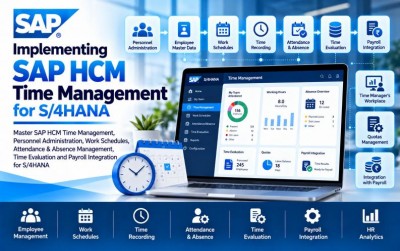
Implementing SAP HCM Time Management for S/4HANA is a comprehensive professional training program designed for SAP HCM Consultants, HR Functional Consultants, SAP Time Management Consultants, Payroll Consultants, SAP S/4HANA Implementation Specialists, HR Administrators, Business Analysts, and SAP certification candidates.
This learning journey provides complete coverage of SAP Human Capital Management (HCM) Time Management for SAP S/4HANA. Learners will explore personnel administration, organizational structures, master data configuration, time recording, work schedules, attendance and absence management, time evaluation, payroll integration, Personnel Calculation Rules (PCRs), and Time Manager's Workplace (TMW).
Effective workforce time management is essential for accurate payroll processing, legal compliance, workforce planning, and employee productivity. SAP HCM Time Management for SAP S/4HANA enables organizations to manage employee working hours, attendance, absences, quotas, time evaluation, and payroll integration through a comprehensive HR solution.
In this course, learners will explore SAP HCM business processes, configure employee master data, build organizational structures, implement time recording, manage work schedules, administer attendance and absence quotas, configure Personnel Calculation Rules (PCRs), execute time evaluation, and integrate time data with payroll.
By the end of this course, learners will be able to implement and manage SAP HCM Time Management solutions that support enterprise HR operations and workforce management.
This module introduces the core business processes of SAP Human Capital Management (HCM) for SAP S/4HANA. Learners will explore personnel administration, organizational structures, time management, payroll, personnel development, employee and manager self-services, analytics, and additional SAP HCM components including SAP SuccessFactors.
This unit introduces SAP Human Capital Management (HCM) within SAP S/4HANA. Learners will understand the overall HCM architecture, business processes, HR modules, enterprise workforce management, and how HCM integrates with payroll, time management, analytics, and SuccessFactors.
This unit explains how employee records are created, maintained, and updated within SAP HCM. Learners will understand personnel administration processes, employee master records, and HR data maintenance.
This unit introduces organizational structures used in SAP HCM, including enterprise structures, organizational units, positions, jobs, and reporting relationships that support HR operations and workforce planning.
This unit focuses on personnel administration processes such as employee hiring, transfers, promotions, organizational changes, and termination activities performed within SAP HCM.
This unit introduces SAP HCM Time Management concepts, including employee attendance, absences, work schedules, time recording, quota management, and payroll integration.
This unit explains SAP Payroll fundamentals, payroll processing concepts, wage calculations, remuneration structures, and integration with personnel administration and time management.
This unit introduces personnel development activities including employee skills management, training, career development, competency planning, and workforce development initiatives.
This unit explains SAP Shared Services and SAP Fiori applications used by employees, managers, and HR administrators for self-service activities and simplified HR operations.
This unit introduces SAP HCM Analytics and demonstrates how HR professionals generate workforce reports, analyze employee information, and support HR decision-making through business analytics.
This unit explores additional SAP HCM components that extend HR functionality beyond core personnel administration and payroll to support enterprise HR operations.
This unit introduces SAP SuccessFactors and explains its relationship with SAP HCM for S/4HANA, including cloud HR capabilities and digital workforce management.
This module focuses on configuring employee master data and organizational structures within SAP HCM. Learners will understand Implementation Guide (IMG) projects, remuneration structures, wage type configuration, infotypes, personnel actions, and dynamic actions required for enterprise HR administration.
This unit introduces user preferences, personalization settings, and navigation options within SAP HCM to improve usability and productivity for HR administrators.
This unit focuses on maintaining employee master data within SAP HCM. Learners will understand how to create, update, validate, and maintain employee records while ensuring data accuracy and supporting HR business processes.
This unit introduces the SAP Implementation Guide (IMG) and explains how HR consultants configure SAP HCM using IMG projects. Learners will understand configuration structures, implementation activities, and project organization.
This unit explains the structural components of SAP HCM, including enterprise structures, personnel structures, organizational assignments, and their role in managing workforce information efficiently.
This unit focuses on organizational structures within SAP HCM, helping learners understand organizational units, jobs, positions, reporting relationships, and workforce hierarchy design.
This unit explains how additional organizational assignments are configured for employees to support enterprise HR processes and reporting requirements.
This unit introduces system default values and configuration settings that simplify HR administration while maintaining consistency across SAP HCM implementations.
This unit explains how personal employee information is updated and maintained while ensuring data accuracy, security, and compliance with organizational policies.
This unit focuses on maintaining consistent employee data across SAP HCM by validating records, preventing duplication, and ensuring data integrity throughout HR processes.
This unit introduces remuneration structures used for employee compensation management. Learners will understand salary structures, compensation components, and remuneration planning within SAP HCM.
This unit explains wage type configuration, wage classifications, payroll processing elements, and how wage types are used during payroll calculation.
This unit demonstrates how remuneration reports are generated and analyzed to support payroll verification, compensation planning, and HR reporting.
This unit introduces SAP HCM infotypes, explaining how employee information is organized, maintained, and processed across HR business functions.
This unit explains personnel actions such as hiring, transfers, promotions, organizational changes, and separations that are executed throughout the employee lifecycle.
This unit introduces dynamic actions, enabling automation of HR tasks based on predefined business rules and employee events within SAP HCM.
This module introduces the core concepts of SAP HCM Time Management. Learners will explore enterprise structures, work schedules, public holiday calendars, attendance and absence recording, quota management, substitution processing, and Time Manager's Workplace (TMW). These capabilities form the foundation of workforce time administration in SAP HCM.
This unit introduces SAP HCM Time Management and explains how organizations manage employee working time, attendance, absences, quotas, and workforce scheduling while ensuring payroll accuracy and labor law compliance.
This unit explains how enterprise structures are configured to support time management processes, including personnel areas, personnel subareas, employee groupings, and organizational assignments.
This unit focuses on work schedule configuration, including daily work schedules, period work schedules, break schedules, and shift planning required for employee time recording.
This unit explains how public holiday calendars and holiday classes are configured to support work schedules, leave calculations, and payroll processing.
This unit introduces attendance recording and explains how employee working hours are captured, validated, and maintained for accurate payroll and workforce reporting.
This unit explains absence management, including leave requests, leave administration, sickness recording, and absence processing within SAP HCM.
This unit focuses on attendance and absence quota configuration, enabling organizations to manage employee leave balances, accrual rules, quota generation, and entitlement calculations.
This unit explains employee substitutions, temporary schedule changes, and workforce replacement scenarios that support operational continuity within organizations.
This unit introduces Time Manager's Workplace (TMW), enabling administrators to monitor employee time data, review exceptions, process corrections, and manage workforce activities through a centralized interface.
This module focuses on advanced SAP HCM Time Management topics, including time evaluation, evaluation messages, Personnel Calculation Rules (PCRs), the standard Time Evaluation Schema TM00, and payroll integration. Learners will understand how time data is processed and evaluated for enterprise payroll and compliance.
This unit introduces SAP Time Evaluation and explains how employee attendance, absences, quotas, and work schedules are evaluated to generate accurate payroll-relevant time results.
This unit explains how to execute time evaluation, interpret evaluation messages, identify processing issues, and validate employee time records before payroll execution.
This unit introduces the RPTIME00 report and demonstrates how it is used to process, evaluate, and review employee time data within SAP HCM Time Management.
This unit introduces Personnel Calculation Rules (PCRs) and explains how they are used to control time evaluation processing, calculate employee working time, and implement organization-specific business rules within SAP HCM Time Management. Learners will understand how PCRs influence attendance, absences, overtime, and payroll-relevant time calculations.
This unit focuses on the standard Time Evaluation Schema TM00, explaining its structure, processing sequence, functions, operations, and customization techniques used to support enterprise time evaluation requirements.
This unit explains how SAP HCM Time Management integrates with Payroll to ensure accurate wage calculations based on attendance, absences, overtime, work schedules, quotas, and evaluated time data. Learners will understand how evaluated time results support payroll execution and statutory compliance.
Throughout this course, learners will complete practical exercises using SAP HCM Time Management for SAP S/4HANA to configure workforce time administration, evaluate employee time, and integrate results with payroll.
Participants will perform the following exercises:
In this capstone project, learners will implement a complete SAP HCM Time Management solution for a fictional enterprise with multiple business units and employee groups.
The project simulates a real-world SAP HCM implementation, covering personnel administration, work schedules, attendance and absence management, time evaluation, Personnel Calculation Rules (PCRs), and payroll integration.
Configure:
Implement:
Configure:
Implement:
Upon successful completion of this project, learners will be able to: