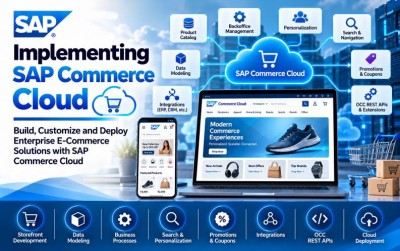
Implementing SAP Commerce Cloud
Master SAP Commerce Cloud Architecture, Development, Storefront Customization, Order Management, Personalization, Search, Promotions, REST APIs, and Enterprise Commerce Solutions
English
Last updated
Sat, 24-Oct-2026
Master SAP Commerce Cloud Architecture, Development, Storefront Customization, Order Management, Personalization, Search, Promotions, REST APIs, and Enterprise Commerce Solutions
English
Last updated
Sat, 24-Oct-2026
Implementing SAP Commerce Cloud is a comprehensive professional training program designed for SAP Commerce Developers, Java Developers, Technical Consultants, Solution Architects, E-Commerce Developers, SAP Customer Experience (CX) Consultants, Cloud Engineers, and SAP certification candidates.
This learning journey provides complete coverage of SAP Commerce Cloud implementation, from technical fundamentals and system configuration to advanced commerce customization, storefront development, search optimization, personalization, promotions, and RESTful web services.
Through hands-on exercises and real-world implementation scenarios, learners will gain practical skills to configure, customize, deploy, and extend enterprise-grade SAP Commerce Cloud solutions
SAP Commerce Cloud is one of SAP's leading enterprise e-commerce platforms, enabling organizations to build scalable B2B, B2C, and omnichannel commerce solutions.
This course takes learners through the complete SAP Commerce Cloud implementation lifecycle. Starting with technical architecture, installation, and configuration, participants will learn data modeling, Backoffice customization, FlexibleSearch, services, facades, process management, workflows, order management, storefront customization, personalization, Adaptive Search, promotions, coupons, and OCC REST APIs.
By the end of this course, learners will have the skills required to build enterprise commerce solutions, customize SAP Commerce Cloud applications, deploy cloud-based commerce platforms, and prepare for SAP Commerce Cloud certification 158 - Implementing SAP Commerce…
This course aligns with the SAP Learning Journey Implementing SAP Commerce Cloud and prepares learners for SAP Commerce Cloud implementation topics including technical architecture, Backoffice Framework, data modeling, process management, storefront customization, personalization, search, promotions, coupons, and OCC REST APIs
This module introduces the core technical foundations of SAP Commerce Cloud. Learners will understand the platform architecture, installation and configuration, Backoffice Framework, data modeling, product modeling, data import and export, FlexibleSearch, services, and facades.
By completing this module, learners will gain the knowledge required to build, configure, and extend SAP Commerce Cloud applications while understanding the architecture that powers enterprise digital commerce solutions
This unit introduces SAP Commerce Cloud, its architecture, core components, deployment models, development environment, and enterprise commerce capabilities. Learners will understand how SAP Commerce Cloud supports modern B2B, B2C, and omnichannel digital commerce solutions.
This unit explains the installation, configuration, environment preparation, and deployment prerequisites for SAP Commerce Cloud. Learners will understand how development environments are configured for enterprise commerce implementations.
This unit introduces the SAP Commerce Cloud Backoffice Framework, enabling administrators and developers to manage products, catalogs, users, orders, business processes, and administrative tasks through a centralized management interface.
This unit explains enterprise data modeling within SAP Commerce Cloud. Learners will understand item types, attributes, relationships, inheritance, and data structures that define business objects throughout the commerce platform.
This unit focuses on product modeling, including products, variants, categories, catalogs, classification systems, and product information management within SAP Commerce Cloud.
This unit introduces SAP Commerce Cloud data migration capabilities using import and export features. Learners will manage enterprise product, customer, pricing, and catalog data efficiently.
This unit explains FlexibleSearch, SAP Commerce Cloud's powerful query language used to retrieve and manipulate enterprise commerce data efficiently.
This unit focuses on the service layer architecture, business services, dependency injection, and reusable service components that power enterprise commerce applications.
This unit introduces the facade layer used within SAP Commerce Cloud to simplify communication between controllers and business services while supporting clean enterprise application architecture.
This module expands on the technical foundation of SAP Commerce Cloud by introducing enterprise security, event-driven communication, process management, order management customization, CronJobs, workflows, validation, and Web Content Management (WCM).
Learners will gain practical knowledge for extending enterprise commerce applications, automating business processes, and improving platform administration
This unit introduces the SAP Commerce Cloud practice environment, providing learners with access to hands-on development systems where they can configure, develop, and test enterprise commerce applications.
This unit explains how to build, package, deploy, and manage SAP Commerce Cloud applications using the SAP Commerce Cloud Portal while understanding deployment workflows and cloud lifecycle management.
This unit introduces the security framework of SAP Commerce Cloud. Learners will understand authentication, authorization, user roles, access permissions, password policies, and security configuration required to protect enterprise commerce applications.
This unit explains event-driven architecture within SAP Commerce Cloud. Learners will configure event-based communication mechanisms to automate business processes and improve application responsiveness.
This unit introduces the SAP Commerce Process Engine used to automate business workflows such as order processing, customer notifications, fulfillment, and enterprise commerce operations.
This unit focuses on customizing enterprise order management processes, including order lifecycle management, fulfillment workflows, order validation, shipment processing, and customer order handling.
This unit explains CronJobs in SAP Commerce Cloud and demonstrates how scheduled jobs automate maintenance tasks, synchronization, indexing, imports, exports, and recurring business operations.
This unit introduces workflow development that enables business users to collaborate on approvals, content publishing, product management, and enterprise commerce activities.
This unit explains the SAP Commerce Cloud Validation Framework used to enforce business rules, validate enterprise data, improve data quality, and ensure consistency across commerce applications.
This unit introduces Web Content Management (WCM), enabling administrators and marketers to manage website pages, content components, banners, promotions, and digital experiences without modifying application code.
This module focuses on advanced SAP Commerce Cloud capabilities for creating modern, personalized, and high-performing digital commerce experiences. Learners will explore Composable Storefront, SAP Commerce Personalization, search and navigation customization, Adaptive Search, promotions, coupons, RESTful web services, and additional technical capabilities.
By completing this module, learners will gain the skills required to build enterprise-grade commerce solutions that deliver personalized customer experiences and seamless integrations
This unit provides access to the SAP Commerce Cloud practice system for advanced storefront development, personalization, search optimization, and API implementation exercises.
This unit introduces SAP Commerce Cloud Composable Storefront, covering installation, architecture, configuration, and deployment of a modern, flexible, and headless storefront for enterprise commerce applications.
This unit focuses on SAP Commerce Personalization, enabling organizations to deliver customized shopping experiences using customer segmentation, behavioral targeting, and personalized content.
This unit explains search configuration and navigation customization to improve product discovery, category browsing, filtering, sorting, and customer experience within SAP Commerce Cloud.
This unit explains how to create and manage promotions and coupons within SAP Commerce Cloud. Learners will configure promotional campaigns, discount rules, coupon validation, eligibility criteria, and pricing strategies to enhance customer engagement and drive online sales.
This unit introduces OmniCommerce Connect (OCC) REST APIs, enabling developers to expose commerce functionality through secure RESTful services for web, mobile, and third-party applications.
This unit focuses on integrating SAP Commerce Cloud with enterprise applications such as SAP S/4HANA, SAP ERP, CRM, payment gateways, shipping providers, and external business systems using standard integration frameworks and APIs.
This unit explains techniques for optimizing SAP Commerce Cloud performance, monitoring application health, improving scalability, managing cloud deployments, and maintaining highly available enterprise commerce platforms.
Throughout this course, learners will complete practical exercises using SAP Commerce Cloud to gain practical experience in developing, customizing, deploying, and managing enterprise digital commerce applications.
Participants will perform the following exercises:
In this capstone project, learners will implement a complete SAP Commerce Cloud solution for a fictional retail enterprise. The project simulates the implementation of a scalable B2B/B2C commerce platform, including catalog management, storefront customization, order processing, personalization, promotions, search optimization, and enterprise integrations.
Configure and implement:
Implement:
Configure:
Implement:
Upon successful completion of this project, learners will be able to:


Study any topic, anytime. explore thousands of courses for the lowest price ever!