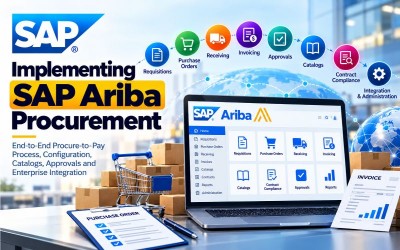
Implementing SAP Ariba Procurement is a comprehensive enterprise training program designed for SAP Ariba consultants, procurement specialists, purchasing professionals, SAP implementation consultants, procurement administrators, functional consultants, solution architects, business analysts, and digital procurement teams who want to implement, configure, administer, and optimize SAP Ariba Procurement solutions.
This course provides practical knowledge of SAP Ariba Buying & Invoicing, Guided Buying, Requisitioning, Receiving, Purchase Order Management, Invoice Creation, Invoice Reconciliation, Advanced Purchasing, Catalog Management, Contract Compliance, Approval Rules, Realm Configuration, Implementation Consulting, and SAP Ariba Integration.
Following SAP's official Learning Journey, the course progresses from SAP Ariba Procurement fundamentals through requisitioning, purchasing, invoicing, catalog management, Guided Buying, configuration, administration, implementation, and enterprise integration.
Modern procurement organizations require intelligent digital procurement solutions that streamline purchasing, improve compliance, automate approvals, reduce procurement costs, and enhance supplier collaboration. SAP Ariba Procurement provides a cloud-based procurement platform that supports the complete procure-to-pay (P2P) lifecycle, including requisitioning, purchase order management, receiving, invoicing, contract compliance, catalogs, Guided Buying, reporting, approvals, and enterprise integration.
This course introduces the complete implementation lifecycle of SAP Ariba Procurement, including SAP Ariba Buying & Invoicing, Guided Buying, purchase requisitions, purchase orders, receiving, invoice processing, invoice reconciliation, procurement reporting, catalog management, contract compliance, approval workflows, realm administration, procurement configuration, implementation consulting, and SAP integration.
Throughout the course, learners will gain practical implementation experience while working through real-world procurement scenarios involving procurement automation, purchasing workflows, supplier collaboration, catalog management, invoice processing, approval configuration, and enterprise procurement best practices.
By the end of this course, participants will possess the knowledge required to implement, configure, administer, optimize, and support SAP Ariba Procurement solutions for enterprise procurement organizations.
These roles are highly valued across manufacturing, retail, healthcare, pharmaceuticals, banking, telecommunications, logistics, government, energy, and global enterprises implementing SAP Ariba Procurement solutions.
This course is designed to support learners preparing for SAP Ariba Procurement Certification by covering the concepts included in SAP's official Learning Journey.
Participants will gain practical knowledge in:
The course combines conceptual learning with practical implementation exercises to prepare learners for enterprise SAP Ariba Procurement projects and certification success.

SAP Ariba Procurement enables organizations to digitize and automate the complete procure-to-pay (P2P) process by managing purchase requisitions, purchase orders, receiving, invoicing, approvals, catalogs, supplier collaboration, and procurement compliance through a cloud-based platform.
This module introduces SAP Ariba Procurement, its architecture, business capabilities, procure-to-pay lifecycle, and the key components of SAP Ariba Buying & Invoicing.
By the end of this module, learners will understand how SAP Ariba Procurement supports efficient purchasing, policy compliance, supplier collaboration, and enterprise procurement automation.
According to the SAP Learning Journey, this module covers SAP Ariba Procurement fundamentals, Buying & Invoicing overview, procure-to-pay processes, and procurement capabilities.
SAP Ariba Procurement provides organizations with intelligent procurement capabilities that automate purchasing activities, improve compliance, streamline approvals, reduce manual work, and enhance supplier collaboration across the complete procure-to-pay lifecycle.
Participants will understand the purpose, architecture, and business value of SAP Ariba Procurement.
SAP Ariba Buying & Invoicing enables organizations to manage procurement requests, purchase orders, receiving, invoice processing, approvals, and procurement compliance through an integrated cloud solution.
Learners will explore the major business capabilities delivered by SAP Ariba Buying & Invoicing.
The Procure-to-Pay (P2P) process covers the complete purchasing lifecycle from purchase requisition creation to supplier payment. Participants will understand procurement workflows, purchasing approvals, supplier collaboration, invoice processing, and procurement governance.
Purchase requisitions, purchase orders, receiving, and invoicing form the core of SAP Ariba Procurement. These processes automate purchasing requests, approvals, supplier communication, goods receipt, invoice matching, and payment preparation while ensuring procurement policy compliance.
This module introduces requisition creation, purchase order management, receiving, invoice processing, invoice reconciliation, and enterprise procurement workflows.
By the end of this module, learners will be able to efficiently manage the complete purchasing lifecycle using SAP Ariba Procurement.
According to the SAP Learning Journey, this module covers requisitions, purchase orders, receiving, invoice processing, invoice reconciliation, and procurement workflows.
Purchase requisitions initiate procurement activities by allowing employees to request goods and services while ensuring approval workflows and procurement policies are followed.
Purchase Orders formally communicate purchasing requirements to suppliers. Participants will learn how to create, manage, approve, modify, and monitor purchase orders throughout the procurement lifecycle.
Receiving confirms that ordered goods or services have been delivered according to procurement requirements. Learners will understand goods receipt processes, receiving confirmations, exceptions, and procurement validation.
Supplier invoice processing automates invoice submission, validation, approval, and payment preparation. This unit explains invoice creation, invoice review, matching, exceptions, and procurement compliance.
Invoice reconciliation compares supplier invoices with purchase orders and goods receipts to ensure procurement accuracy before payment. Participants will understand invoice matching, exception handling, approvals, and reconciliation workflows.
Catalogs and Contract Compliance are essential components of SAP Ariba Procurement, enabling organizations to standardize purchasing, ensure policy compliance, reduce off-contract spending, and simplify the buying experience. SAP Ariba supports hosted catalogs, PunchOut catalogs, catalog subscriptions, contract-based purchasing, and procurement policies that guide users toward approved suppliers and negotiated contracts.
This module introduces catalog management, catalog loading, PunchOut catalogs, contract compliance, purchasing policies, and procurement governance.
By the end of this module, learners will be able to configure and manage procurement catalogs while ensuring enterprise purchasing complies with organizational contracts and procurement policies.
According to the SAP Learning Journey, this module covers catalog management, catalog loading, PunchOut catalogs, contract compliance, and procurement governance.
SAP Ariba Catalog Management enables organizations to provide employees with approved products and services through centralized procurement catalogs. Learners will understand catalog structures, content management, supplier catalogs, and procurement standardization.
Hosted catalogs store supplier product information within SAP Ariba, while PunchOut catalogs allow users to access supplier-maintained online catalogs directly. Participants will learn how to configure, maintain, and manage both catalog types.
Catalog content must be validated to ensure pricing accuracy, product availability, supplier information, and procurement compliance. Learners will configure catalog imports, perform validations, and manage catalog updates.
Contract Compliance ensures purchases are made using approved suppliers and negotiated agreements. SAP Ariba Procurement helps organizations reduce maverick spending by directing buyers toward compliant purchasing options.
SAP Ariba Guided Buying simplifies procurement by providing an intuitive, consumer-like purchasing experience while ensuring organizational purchasing policies are followed. Guided Buying helps employees locate approved suppliers, preferred catalogs, procurement forms, and purchasing channels with minimal training.
This module introduces Guided Buying configuration, user experience, procurement policies, forms, landing pages, machine learning capabilities, and enterprise purchasing guidance.
By the end of this module, learners will be able to configure and optimize SAP Ariba Guided Buying to improve user adoption and procurement compliance.
According to the SAP Learning Journey, this module covers Guided Buying, forms, landing pages, machine learning, procurement policies, and user experience.
Guided Buying provides users with a modern purchasing experience that simplifies procurement while directing employees to approved suppliers, purchasing channels, and procurement policies.
Forms and landing pages guide users through procurement processes by presenting relevant purchasing options, policy information, supplier recommendations, and request forms based on business needs.
Procurement policies define purchasing rules, supplier eligibility, spending limits, approval requirements, and purchasing guidance. Learners will configure policies that support compliant and efficient procurement.
SAP Ariba Guided Buying incorporates intelligent capabilities such as machine learning recommendations, personalized purchasing experiences, and automated procurement guidance to improve purchasing efficiency and user satisfaction.
Approval rules and realm administration enable organizations to control procurement workflows, enforce purchasing policies, manage users, configure system settings, and maintain governance across SAP Ariba Procurement. Proper configuration ensures that purchasing activities comply with organizational policies while providing secure and efficient procurement operations.
This module introduces approval workflows, approval rules, realm configuration, user management, commodity codes, custom fields, dashboards, and enterprise administration.
By the end of this module, learners will be able to configure approval processes and administer SAP Ariba Procurement environments.
According to the SAP Learning Journey, this module covers approval rules, realm configuration, administration, users, commodity codes, custom fields, dashboards, and enterprise procurement settings.
Approval rules ensure procurement requests follow organizational approval hierarchies based on purchasing value, department, commodity, supplier, or business policies. Participants will configure approval flows that automate purchasing governance and compliance.
Realm configuration enables administrators to define enterprise procurement settings, organizational preferences, procurement policies, system parameters, and purchasing behavior that support business operations.
User administration controls access to procurement functionality by assigning users, groups, permissions, approval authority, and security roles according to organizational responsibilities.
Commodity codes classify purchased goods and services, while custom fields allow organizations to capture additional procurement information specific to business requirements. Learners will configure procurement classifications and custom attributes.
Dashboards provide procurement professionals with visibility into purchasing activities, approvals, spending, and operational performance. This unit introduces dashboard configuration, widgets, procurement metrics, and user personalization.
SAP Ariba Procurement integrates with SAP ERP, SAP S/4HANA, SAP Business Network, Cloud Integration Gateway (CIG), and third-party enterprise applications to provide seamless procurement operations, synchronized master data, and automated transactional processing.
This module introduces procurement integration architecture, master data integration, transactional integration, SAP Business Network connectivity, Cloud Integration Gateway, catalog syndication, and enterprise integration best practices.
By the end of this module, learners will be able to configure and support SAP Ariba Procurement integrations across enterprise systems.
According to the SAP Learning Journey, this module covers master data integration, Cloud Integration Gateway, transactional integration, SAP Business Network integration, catalog syndication, and enterprise application integration.
SAP Ariba Procurement integrates with enterprise applications to synchronize procurement data, supplier information, purchasing documents, invoices, and master data while ensuring secure and reliable communication between systems.
Master data integration synchronizes suppliers, users, accounting information, commodity codes, purchasing organizations, and other procurement master data between SAP Ariba Procurement and ERP systems.
Transactional integration enables procurement documents such as purchase requisitions, purchase orders, receipts, invoices, and approvals to flow automatically between SAP Ariba Procurement and backend ERP systems.
SAP Business Network and Cloud Integration Gateway (CIG) enable seamless communication between SAP Ariba Procurement and enterprise ERP systems. Organizations can automate supplier collaboration, purchase order transmission, invoice exchange, catalog synchronization, and procurement document processing through secure integrations.
Participants will learn how to configure SAP Business Network connectivity, Cloud Integration Gateway, and integration scenarios that support end-to-end procurement processes.
Catalog Syndication enables organizations to publish, distribute, and synchronize procurement catalogs between suppliers, SAP Ariba Procurement, and external procurement systems. Learners will understand catalog publication, synchronization, validation, and supplier content management.
Successful SAP Ariba Procurement implementations require secure, scalable, and reliable integrations with enterprise systems. This unit introduces integration governance, security, monitoring, error handling, performance optimization, and implementation best practices.
Throughout this course, learners will complete practical exercises that simulate real-world SAP Ariba Procurement implementation scenarios.
Participants will perform the following hands-on activities:
This capstone project enables learners to implement a complete SAP Ariba Procurement solution for a global enterprise procurement organization.
Participants will configure SAP Ariba Buying & Invoicing, Guided Buying, procurement catalogs, purchase requisitions, purchase orders, goods receiving, invoice processing, approval workflows, procurement reporting, realm administration, Cloud Integration Gateway, SAP Business Network integration, and enterprise procurement governance while following SAP implementation best practices.
The implementation project follows the complete SAP Learning Journey for SAP Ariba Procurement implementation.
Configure:
Implement:
Configure:
Implement:
Configure:
Upon successful completion of this implementation project, learners will be able to: