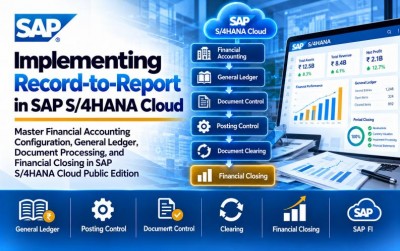
Implementing Record-to-Report in SAP S/4HANA Cloud is an advanced SAP S/4HANA Cloud Public Edition course designed for SAP Finance consultants, implementation specialists, finance professionals, ERP solution architects, and SAP certification candidates.
This learning journey provides a comprehensive understanding of configuring and implementing the Record-to-Report (R2R) process within SAP S/4HANA Cloud Public Edition. Learners will gain practical knowledge of Financial Accounting core settings, General Ledger configuration, financial document control, posting control, document clearing, and financial closing activities required to support enterprise financial reporting.
By completing this course, participants will be able to configure essential Financial Accounting components that enable accurate financial transactions, efficient closing processes, and compliant financial reporting within SAP S/4HANA Cloud Public Edition.
The Record-to-Report (R2R) process is one of the most critical financial processes in SAP S/4HANA Cloud. It integrates organizational structures, General Ledger Accounting, financial postings, document processing, document clearing, and financial closing activities into a unified accounting framework.
This course teaches learners how to configure the Financial Accounting components required to support enterprise accounting operations. Participants will learn to maintain organizational units, customize General Ledger master records, configure document control settings, manage posting controls, perform document clearing, and implement financial closing configurations including valuation and balance sheet reclassification.
The course emphasizes configuration best practices while preparing learners for real-world SAP S/4HANA Cloud implementation projects and SAP certification.
Financial Accounting Core Settings provide the organizational and configuration foundation for all accounting activities within SAP S/4HANA Cloud Public Edition. Correctly configuring these settings ensures that financial transactions, reporting, and integrations function consistently across the enterprise.
This module introduces the essential organizational structures used in Financial Accounting and explains how General Ledger settings support business processes and statutory reporting. Learners will gain practical knowledge of maintaining Financial Accounting organizational units and configuring core General Ledger settings required during SAP implementations.
This unit explains the organizational structures required for Financial Accounting in SAP S/4HANA Cloud Public Edition. Learners will understand how Company Codes and Financial Accounting organizational units are maintained to support enterprise financial operations.
This unit introduces the General Ledger configuration settings required for Financial Accounting. Learners will understand how General Ledger settings influence accounting transactions, financial reporting, and overall system behavior.
General Ledger (G/L) master records are fundamental components of Financial Accounting that define how financial transactions are classified, posted, and reported. Proper configuration of G/L master records ensures consistency, compliance, and accurate financial reporting across the organization.
This module focuses on managing the Chart of Accounts, configuring General Ledger account settings, and maintaining G/L master records. Learners will understand the structure and configuration required to support enterprise accounting and financial reporting.
This unit introduces the Chart of Accounts and explains how it organizes financial information within SAP S/4HANA Cloud Public Edition. Learners will understand account hierarchies and their role in enterprise accounting.
This unit explains the essential settings required for General Ledger accounts, enabling organizations to manage financial transactions consistently while supporting reporting requirements.
This unit focuses on maintaining General Ledger master records and understanding how properly configured G/L accounts support business transactions, financial reporting, and enterprise accounting processes.
Financial Document Control is a critical component of the Record-to-Report process, ensuring that financial transactions are recorded accurately, consistently, and in compliance with organizational accounting policies. SAP S/4HANA Cloud Public Edition provides configurable document types, posting keys, field status groups, and document reversal mechanisms to support controlled financial processing.
This module introduces the configuration of financial document controls, helping learners understand how accounting documents are managed throughout their lifecycle. Participants will learn to configure document settings, control accounting postings, and perform document reversals while maintaining financial integrity.
This unit introduces the key configuration settings used to control financial documents in SAP S/4HANA Cloud Public Edition. Learners will understand document types, posting keys, field status groups, and their role in financial transaction processing.
This unit explains how document control settings influence accounting transactions, posting validation, and financial consistency. Learners will explore configuration options used to manage financial documents throughout business operations.
This unit focuses on document reversal procedures within SAP Financial Accounting. Learners will understand how document reversals are configured and used to correct accounting entries while maintaining audit compliance.
Financial Posting Control governs how accounting documents are posted, validated, parked, and processed within SAP S/4HANA Cloud Public Edition. Proper posting control configuration helps organizations maintain financial accuracy, enforce approval processes, and improve governance over accounting transactions.
This module introduces posting control parameters, default values, document parking, workflow processes, and change control settings that support secure and efficient financial operations. Learners will gain practical knowledge of configuring posting controls to improve accounting quality and streamline financial processing.
This unit introduces the configuration of posting control parameters used to regulate accounting postings. Learners will understand posting controls, default values, change management, and the impact of configuration on financial transactions.
This unit explains how document parking enables draft accounting documents to be reviewed and approved before final posting. Learners will also explore workflow processes that support approval and control within financial operations.
Document Clearing is an essential part of the Record-to-Report (R2R) process that ensures open financial items are matched and cleared accurately. Effective document clearing helps organizations maintain accurate account balances, reconcile transactions, and improve financial transparency.
This module focuses on configuring document clearing in SAP S/4HANA Cloud Public Edition. Learners will understand the concepts of open item management, manual document clearing, automatic clearing for GR/IR accounts, and the configuration settings required to support efficient financial reconciliation.
This unit introduces the document clearing process within the Record-to-Report cycle. Learners will understand how open items are managed, how General Ledger accounts support clearing activities, and why document clearing is essential for maintaining accurate financial records.
This unit focuses on performing document clearing activities using manual and automatic clearing methods. Learners will explore how SAP S/4HANA Cloud Public Edition manages open items and automates the clearing of financial transactions to improve accounting efficiency.
Financial Closing is one of the most important phases of enterprise accounting. SAP S/4HANA Cloud Public Edition provides comprehensive configuration capabilities for period-end and year-end closing, ensuring compliance with accounting standards while delivering accurate financial reporting.
This module introduces the configuration of Financial Statement Versions, semantic tags, advanced valuation, foreign currency valuation, credit-risk-based impairment, discounting of long-term assets and liabilities, and balance sheet reclassification. Learners will understand how these configurations support accurate financial statements and regulatory compliance.
This unit introduces Financial Statement Versions (FSVs) and explains how they are configured to organize financial reports. Learners will understand semantic tags, reporting structures, and how Financial Statement Versions support statutory and management reporting.
This unit focuses on advanced financial closing configurations, including advanced valuation, foreign currency valuation, discounting of long-term assets and liabilities, credit-risk-based impairment, and balance sheet reclassification. Learners will understand how these features improve compliance and ensure accurate financial reporting.
Throughout this course, learners will complete implementation-focused, hands-on exercises using SAP S/4HANA Cloud Public Edition – Financial Accounting. These practical activities simulate real-world SAP implementation projects and reinforce the configuration skills required for the Record-to-Report (R2R) process.
Participants will perform the following practical exercises:
In this enterprise implementation project, learners will perform a simulated implementation of the Record-to-Report (R2R) process for a fictional organization using SAP S/4HANA Cloud Public Edition.
Participants will configure the core Financial Accounting components required to support enterprise financial transactions, document processing, reconciliation, and financial closing.
This project mirrors the activities commonly performed by SAP FI consultants during implementation projects.
Configure:
Implement:
Implement:
Configure:
Implement:
Upon successful completion of this project, learners will be able to: