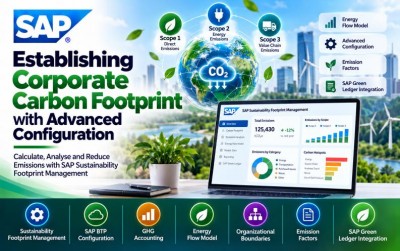
Establishing Corporate Carbon Footprint with Advanced Configuration is a comprehensive professional training program designed for SAP Sustainability Consultants, ESG Consultants, Sustainability Managers, Environmental Analysts, SAP Solution Architects, SAP BTP Consultants, Carbon Accounting Specialists, Business Process Consultants, and SAP certification candidates.
This course provides in-depth knowledge of SAP Sustainability Footprint Management and teaches learners how to configure enterprise carbon accounting processes using advanced configuration techniques. Participants will learn to calculate corporate greenhouse gas (GHG) emissions across Scope 1, Scope 2, and multiple Scope 3 categories using the Energy Flow Model, configure organizational boundaries, define calculation variants, manage emission factors, and communicate corporate carbon footprint data to SAP Green Ledger.
Organizations worldwide are increasingly required to measure, monitor, and reduce their carbon emissions to meet sustainability goals and regulatory requirements. SAP Sustainability Footprint Management enables businesses to calculate accurate corporate carbon footprints using standardized greenhouse gas accounting methodologies.
In this course, learners progress from configuring SAP Sustainability Footprint Management within an SAP Business Technology Platform (SAP BTP) environment to implementing advanced corporate carbon footprint calculations using the Energy Flow Model. They will learn to configure organizational boundaries, define footprint inventory scopes, create calculation variants, model energy flows, calculate Scope 1, Scope 2, and Scope 3 emissions, and communicate results to SAP Green Ledger.
By the end of this course, learners will be able to implement enterprise-ready SAP Sustainability Footprint Management solutions that support ESG reporting, decarbonization initiatives, and corporate sustainability strategies.
This module introduces SAP Sustainability Footprint Management and explains its business architecture, solution components, and configuration within an SAP Business Technology Platform (SAP BTP) account. Learners will understand the foundation required to implement enterprise corporate carbon footprint calculations.
This unit introduces the initial configuration of SAP Sustainability Footprint Management. Learners will understand the business architecture, required SAP Business Technology Platform services, deployment prerequisites, and configuration steps required to establish the sustainability solution for enterprise carbon accounting.
This unit introduces the Energy Flow Model used within SAP Sustainability Footprint Management to calculate greenhouse gas emissions for Scope 1, Scope 2, and Scope 3.3. Learners will understand how enterprise energy consumption contributes to corporate carbon footprint calculations.
This unit explains how SAP Sustainability Footprint Management calculates Scope 3.1 emissions, enabling organizations to account for greenhouse gas emissions associated with purchased goods and services as part of enterprise sustainability reporting.
This unit introduces the calculation of Scope 3.4 emissions, helping organizations evaluate greenhouse gas emissions associated with upstream transportation and distribution activities using SAP Sustainability Footprint Management.
This unit explains the calculation of Scope 3.5 emissions, supporting enterprise sustainability reporting by accounting for greenhouse gas emissions associated with waste generated during operations.
This unit introduces Scope 3.11 emissions, enabling organizations to calculate greenhouse gas emissions associated with the use of sold products as part of comprehensive corporate carbon footprint reporting.
This unit explains how corporate carbon footprint data generated in SAP Sustainability Footprint Management is communicated to SAP Green Ledger, supporting enterprise sustainability reporting, financial integration, and ESG transparency.
This module focuses on calculating Corporate Greenhouse Gas (GHG) Emissions using the Energy Flow Model in SAP Sustainability Footprint Management. Learners will configure organizational boundaries, footprint inventory scopes, source data, calculation variants, energy sources, meters, facilities, and emission factors required for accurate corporate carbon footprint calculations.
This unit introduces the complete process of configuring and executing greenhouse gas calculations for Scope 1, Scope 2, and Scope 3.3 using the Energy Flow Model in SAP Sustainability Footprint Management. Learners will understand how enterprise energy data, organizational boundaries, calculation variants, and emission factors are combined to produce accurate corporate carbon footprint results.
This unit explains how to prepare and configure the source data required for Corporate Carbon Footprint (CCF) calculations. Learners will understand how business data is collected, validated, and organized before greenhouse gas calculations are performed in SAP Sustainability Footprint Management.
This unit explains how to define organizational boundaries for corporate carbon accounting. Learners will understand how business entities, legal organizations, operational units, and reporting structures are configured to ensure accurate greenhouse gas reporting.
This unit introduces footprint inventory scope configuration, enabling organizations to determine which greenhouse gas emissions are included within corporate sustainability reporting and carbon footprint calculations.
This unit explains how to configure calculation variants that define different approaches for greenhouse gas calculations based on reporting requirements, organizational policies, and sustainability objectives.
This unit explains how energy sources are configured within the Energy Flow Model to support accurate greenhouse gas calculations for electricity, fuels, and other energy consumption sources.
This unit introduces the configuration of enterprise facilities, operational locations, and energy meters used for collecting energy consumption data that supports accurate corporate carbon footprint calculations.
This unit explains how emission factors are managed within SAP Sustainability Footprint Management to convert energy consumption and operational activities into standardized greenhouse gas emission values.
This unit demonstrates how corporate carbon footprint calculations are executed after all configuration activities have been completed, producing greenhouse gas emission results for enterprise sustainability reporting.
This unit explains how calculated greenhouse gas emissions are reviewed, validated, and prepared for sustainability reporting to ensure consistency, transparency, and regulatory compliance.
Throughout this course, learners will complete practical exercises that simulate real-world implementation of SAP Sustainability Footprint Management for calculating and reporting an organization's Corporate Carbon Footprint (CCF). These exercises focus on configuring SAP Sustainability Footprint Management, greenhouse gas accounting, Energy Flow Model implementation, emission factor management, and SAP Green Ledger integration.
Participants will perform the following exercises:
In this capstone project, learners will implement a complete Corporate Carbon Footprint (CCF) solution using SAP Sustainability Footprint Management.
The project simulates a multinational organization that needs to calculate greenhouse gas emissions across multiple business units, configure advanced sustainability settings, integrate SAP Green Ledger, and produce ESG-ready sustainability reports.
Configure:
Implement:
Configure:
Implement:
Upon successful completion of this project, learners will be able to: