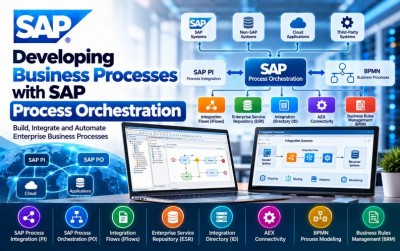
Developing Business Processes with SAP Process Orchestration is a comprehensive professional training program designed for SAP Integration Developers, SAP Process Orchestration Consultants, SAP PI/PO Developers, SAP Technical Consultants, SAP Integration Architects, SAP Middleware Specialists, SAP NetWeaver Developers, Enterprise Integration Engineers, and SAP certification candidates.
This course provides a complete understanding of SAP Process Orchestration (SAP PO) and SAP Process Integration (SAP PI). Learners will understand how to create enterprise business processes, integration scenarios, integration flows (iFlows), and business process automation using SAP NetWeaver Developer Studio, Enterprise Service Repository (ESR), Integration Directory (ID), Business Process Management (BPM), and Business Rules Management (BRM).
Modern enterprises rely on seamless integration between SAP and non-SAP systems to automate business processes and exchange information securely. SAP Process Orchestration combines integration capabilities with business process management, enabling organizations to build scalable, reliable, and reusable integration solutions.
In this course, learners begin by understanding the SAP Process Integration architecture, Enterprise Service Repository, Integration Directory, connectivity options, adapters, testing tools, and advanced mapping concepts. They then progress to SAP Process Orchestration, learning how to design BPMN processes, build integration flows (iFlows), configure connectivity through the Advanced Adapter Engine Extended (AEX), deploy business processes, monitor execution, and implement business rules.
By the end of this course, learners will be able to develop enterprise-ready business process integrations using SAP Process Orchestration and SAP Process Integration.
This course aligns with the SAP Learning Journey Developing Business Processes with SAP Process Orchestration and prepares learners to develop business processes, create integration scenarios, configure SAP Process Integration, build iFlows, implement BPMN processes, and manage enterprise integration solutions.

This module introduces SAP Process Integration (SAP PI) and the core tools required to create enterprise integration scenarios and business processes. Learners will explore SAP PI architecture, SAP NetWeaver Developer Studio, Enterprise Service Repository (ESR), Integration Directory (ID), connectivity options, adapters, testing tools, and advanced mapping concepts.
This unit introduces the architecture of SAP Process Integration (SAP PI) and explains the key components involved in enterprise application integration. Learners will understand how SAP PI enables communication between SAP and non-SAP systems while supporting scalable integration scenarios.
This unit explains the System Landscape Directory (SLD) and its role in maintaining technical system information, software components, and landscape data used throughout SAP Process Integration.
This unit introduces the Enterprise Service Repository (ESR) and explains how interface objects are created and managed to support enterprise integration scenarios and message processing.
This unit focuses on creating object mappings within the Enterprise Service Repository (ESR) to transform and exchange business data between integrated systems.
This unit explains how Integration Directory (ID) objects are configured to define communication channels, routing, and integration scenarios between enterprise applications.
This unit introduces SAP Process Integration operational activities, including monitoring, administration, runtime processing, and operational management of enterprise integration scenarios.
This unit explains the various connectivity options available in SAP Process Integration for integrating SAP and third-party applications across enterprise landscapes.
This unit explains how HTTP connectivity is implemented in SAP Process Integration, enabling secure communication between enterprise systems using HTTP-based integration services.
This unit introduces the File Adapter and explains how file-based communication is configured to exchange business data between enterprise systems.
This unit explains how the SAP Process Integration Test Tool is used to validate integration scenarios, troubleshoot message processing, and verify enterprise integration configurations.
This unit demonstrates how cloud integration content is executed using SAP Process Integration, enabling hybrid integration between cloud-based and on-premise enterprise systems.
This unit introduces additional connectivity options available within SAP Process Integration to support enterprise integration requirements beyond standard HTTP and File adapters.
This unit explains advanced mapping concepts used within SAP Process Integration to support complex message transformations and enterprise integration scenarios.
This module introduces SAP Process Orchestration (SAP PO) and explains how enterprise business processes are modeled, automated, deployed, and monitored. Learners will use SAP NetWeaver Developer Studio to create Integration Flows (iFlows), design BPMN processes, implement connectivity using the Advanced Adapter Engine Extended (AEX), and integrate Business Rules Management (BRM) into enterprise process automation.
This unit introduces SAP Process Orchestration (SAP PO), explaining its architecture, capabilities, and role in integrating enterprise applications while automating business processes through SAP Business Process Management and SAP Process Integration.
This unit explains how to create Integration Flows (iFlows) that orchestrate communication between enterprise systems. Learners will configure message routing, transformations, adapters, and processing logic within SAP Process Orchestration.
This unit introduces SAP NetWeaver Developer Studio and demonstrates how it is configured for developing enterprise integration projects, business processes, and SAP Process Orchestration applications.
This unit explains how Business Process Model and Notation (BPMN) is used to model enterprise business workflows before implementation. Learners will create process diagrams representing real-world business operations.
This unit demonstrates how Business Process Management (BPM) processes are developed within SAP Process Orchestration using process models, events, gateways, service calls, and workflow logic.
This unit explains how the Advanced Adapter Engine Extended (AEX) provides enterprise connectivity by managing adapters, message processing, and communication between SAP and third-party applications.
This unit explains how enterprise business processes are tested, validated, and deployed to production environments while ensuring reliability, performance, and successful execution.
This unit introduces monitoring tools available within SAP Process Orchestration for tracking business process execution, identifying issues, monitoring message flows, and maintaining enterprise integrations.
This unit explains how composite applications are developed by combining multiple enterprise services, business processes, and integration scenarios into unified business applications.
This unit introduces Business Rules Management (BRM) and explains how business rules are separated from application logic, enabling organizations to manage changing business requirements more efficiently.
Throughout this course, learners will complete practical exercises that simulate real-world enterprise integration projects using SAP Process Orchestration (SAP PO) and SAP Process Integration (SAP PI). These exercises cover integration design, Enterprise Service Repository (ESR), Integration Directory (ID), Integration Flows (iFlows), BPMN process modeling, Advanced Adapter Engine Extended (AEX), adapters, message mappings, testing, deployment, and Business Rules Management (BRM).
Participants will perform the following exercises:
In this capstone project, learners will act as SAP Process Orchestration Consultants responsible for implementing an enterprise-wide business process integration solution for a multinational organization.
The project demonstrates how SAP Process Integration and SAP Process Orchestration work together to automate business workflows, integrate SAP and non-SAP applications, manage enterprise message exchanges, and improve operational efficiency.
Configure:
Implement:
Develop:
Implement:
Upon successful completion of this project, learners will be able to: