Course description

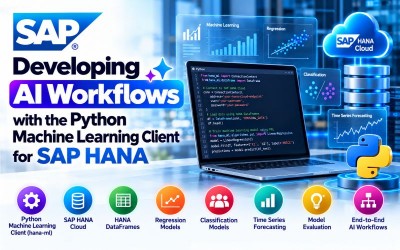
Developing AI Workflows with the Python Machine Learning Client for SAP HANA is a comprehensive enterprise training program designed for Python Developers, Data Scientists, Machine Learning Engineers, SAP HANA Developers, AI Engineers, Data Analysts, Analytics Consultants, SAP AI Specialists, and Solution Architects who want to build, train, evaluate, and deploy machine learning models using SAP HANA Cloud and the Python Machine Learning Client (hana-ml).

This course provides practical knowledge of Python Machine Learning Client (hana-ml), SAP HANA Cloud, HANA DataFrames, Predictive Analysis Library (PAL), Regression Models, Classification Models, Time Series Forecasting, Data Preparation, Model Evaluation, Machine Learning Workflows, and Enterprise AI Development.

Following SAP's official Learning Journey, the course progresses from AI and machine learning fundamentals through data exploration, regression modeling, classification modeling, time-series forecasting, model evaluation, and end-to-end AI workflow implementation using SAP HANA Cloud.

Artificial Intelligence and Machine Learning have become essential technologies for organizations seeking to transform business data into actionable insights. SAP HANA Cloud, together with the Python Machine Learning Client (hana-ml) and the Predictive Analysis Library (PAL), enables developers and data scientists to create scalable, enterprise-grade machine learning workflows directly within SAP HANA.

This course introduces the complete lifecycle of developing AI workflows using the Python Machine Learning Client for SAP HANA, including environment setup, secure SAP HANA Cloud connectivity, HANA DataFrames, data preparation, exploratory data analysis, regression modeling, classification modeling, time-series forecasting, model evaluation, and deployment-ready machine learning pipelines.

Throughout the course, learners will gain practical implementation experience using real-world datasets such as California Housing Prices, Employee Churn Prediction, and Time Series Forecasting to design, build, train, evaluate, and optimize machine learning models using SAP HANA Predictive Analysis Library (PAL).

By the end of this course, participants will possess the practical skills required to develop enterprise AI solutions using Python and SAP HANA Cloud while following modern machine learning best practices.

Who Should Attend

  • Python Developers
  • Data Scientists
  • Machine Learning Engineers
  • SAP HANA Developers
  • AI Engineers
  • Data Analysts
  • SAP AI Consultants
  • SAP Analytics Consultants
  • Solution Architects
  • Data Engineers
  • Cloud Developers
  • Business Intelligence Professionals
  • SAP BTP Developers
  • Analytics Specialists
  • Enterprise AI Developers

Skills You Will Gain

  • Python Machine Learning Client (hana-ml)
  • SAP HANA Cloud
  • HANA DataFrames
  • Machine Learning Fundamentals
  • Data Preparation
  • Exploratory Data Analysis (EDA)
  • Regression Modeling
  • Classification Modeling
  • Time Series Forecasting
  • Predictive Analysis Library (PAL)
  • Model Evaluation
  • AI Workflow Development
  • Enterprise AI
  • Business Analytics
  • SAP HANA Machine Learning

Career Opportunities

  • Machine Learning Engineer
  • Python AI Developer
  • SAP HANA Machine Learning Developer
  • Data Scientist
  • AI Consultant
  • Analytics Consultant
  • Data Engineer
  • SAP AI Specialist
  • SAP HANA Developer
  • Business Intelligence Developer
  • AI Solution Architect
  • Predictive Analytics Engineer
  • Enterprise AI Developer
  • Cloud AI Engineer
  • SAP Analytics Specialist

These roles are highly valued across finance, manufacturing, healthcare, retail, logistics, telecommunications, insurance, government, pharmaceuticals, and enterprises implementing AI and analytics solutions on SAP HANA Cloud.

Certification Preparation

This course is designed to support learners preparing for SAP AI and SAP HANA Machine Learning-related learning paths by covering the concepts included in SAP's official Learning Journey.

Participants will gain practical knowledge in:

  • Python Machine Learning Client (hana-ml)
  • SAP HANA Cloud Connectivity
  • HANA DataFrames
  • Predictive Analysis Library (PAL)
  • Regression Models
  • Classification Models
  • Time Series Forecasting
  • Model Evaluation
  • Enterprise AI Workflows
  • Business Data Analytics

The course combines conceptual learning with practical implementation exercises to prepare learners for enterprise AI development projects using SAP HANA Cloud.

What will i learn?

  • Install and configure the Python Machine Learning Client (hana-ml).
  • Securely connect Python applications to SAP HANA Cloud.
  • Use HANA DataFrames for machine learning.
  • Prepare and analyze enterprise datasets.
  • Build regression models using PAL.
  • Develop classification models.
  • Implement time-series forecasting models.
  • Evaluate machine learning models using appropriate metrics.
  • Build complete end-to-end AI workflows.
  • Apply machine learning to real-world business scenarios.

Requirements

  • Basic Python programming
  • Basic SQL knowledge
  • Understanding of databases
  • Basic statistics (recommended)
  • Interest in Artificial Intelligence and Machine Learning
  • Computer or Laptop
  • Stable Internet Connection
  • Python 3.x
  • SAP HANA Cloud Trial or Enterprise Environment (Recommended)
  • Python Machine Learning Client (hana-ml)

Frequently asked question

Yes. The course begins with machine learning fundamentals, Python Machine Learning Client configuration, and SAP HANA Cloud connectivity before progressing to advanced AI workflows.

No. Basic Python knowledge is recommended, but the course introduces SAP HANA Cloud connectivity and machine learning concepts from the beginning.

Yes. The course teaches installation, configuration, secure SAP HANA Cloud connectivity, HANA DataFrames, and machine learning workflows using the Python Machine Learning Client.

Yes. You will learn to train and evaluate regression models using the California Housing dataset with SAP HANA Predictive Analysis Library (PAL).

Yes. The course covers employee churn prediction using classification algorithms, HANA DataFrames, PAL functions, and model evaluation techniques.

Yes. You will build and evaluate time-series forecasting models using SAP HANA PAL and real-world forecasting datasets.

Yes. The course uses business-focused datasets including California Housing Prices, Employee Churn Prediction, and Overnight Stay Forecasting to build complete end-to-end machine learning workflows.

You will gain hands-on experience configuring hana-ml, connecting to SAP HANA Cloud, preparing data with HANA DataFrames, building regression, classification, and forecasting models, evaluating results, and developing enterprise AI workflows.

  • Lesson 01 00:00:00
    Module 1 Overview

    The Python Machine Learning Client (hana-ml) enables developers and data scientists to build scalable machine learning solutions directly on SAP HANA Cloud using Python. It provides native integration with SAP HANA's in-database machine learning capabilities through the Predictive Analysis Library (PAL), allowing data preparation, model training, evaluation, and prediction without moving data outside the database.

    This module introduces Artificial Intelligence (AI), Machine Learning (ML), SAP HANA Cloud, the Python Machine Learning Client (hana-ml), environment setup, SAP HANA Cloud connectivity, HANA DataFrames, and the fundamentals of enterprise AI workflows.

    By the end of this module, learners will be able to install, configure, and connect the Python Machine Learning Client to SAP HANA Cloud while understanding the architecture and workflow of in-database machine learning.

    According to the SAP Learning Journey, this module covers AI fundamentals, machine learning concepts, SAP HANA Cloud, Python Machine Learning Client installation, connectivity, and HANA DataFrames.

    What You Will Learn

    • Understand Artificial Intelligence and Machine Learning concepts.
    • Explore SAP HANA Cloud architecture.
    • Install the Python Machine Learning Client (hana-ml).
    • Configure the Python development environment.
    • Connect Python applications to SAP HANA Cloud.
    • Work with HANA DataFrames.
    • Explore enterprise datasets.
    • Build the foundation for AI workflows.

    Units in This Module

    • Unit 1.1: Introduction to Artificial Intelligence and Machine Learning
    • Unit 1.2: Understanding SAP HANA Cloud for Machine Learning
    • Unit 1.3: Installing the Python Machine Learning Client (hana-ml)
    • Unit 1.4: Connecting Python to SAP HANA Cloud
    • Unit 1.5: Working with HANA DataFrames
  • Lesson 02 00:00:00
    1.1 Introduction to Artificial Intelligence and Machine Learning

    Artificial Intelligence (AI) and Machine Learning (ML) enable organizations to analyze data, identify patterns, make predictions, and automate business decisions. Participants will understand the fundamentals of AI, supervised learning, unsupervised learning, and enterprise machine learning applications.

    Key Topics

    • Artificial Intelligence
    • Machine Learning
    • Deep Learning
    • Supervised Learning
    • Unsupervised Learning
    • Enterprise AI
    • Predictive Analytics
    • Business Intelligence
  • Lesson 03 00:00:00
    1.2 Understanding SAP HANA Cloud for Machine Learning

    SAP HANA Cloud provides an intelligent data platform that combines database services, analytics, and machine learning capabilities. Learners will understand how SAP HANA Cloud supports enterprise AI workloads using in-database processing.

    Key Topics

    • SAP HANA Cloud
    • Cloud Database
    • In-Database Machine Learning
    • Predictive Analysis Library (PAL)
    • Enterprise Data Platform
    • Cloud Analytics
    • AI Platform
    • SAP HANA
  • Lesson 04 00:00:00
    1.3 Installing the Python Machine Learning Client (hana-ml)

    The Python Machine Learning Client (hana-ml) enables developers to access SAP HANA machine learning libraries directly from Python. Participants will install and configure hana-ml and prepare the development environment.

    Key Topics

    • Python Machine Learning Client
    • hana-ml
    • Python Installation
    • Environment Setup
    • Package Management
    • Python Libraries
    • Development Environment
    • SAP HANA Connectivity
  • Lesson 05 00:00:00
    1.4 Connecting Python to SAP HANA Cloud

    Connecting Python applications securely to SAP HANA Cloud enables developers to perform data analysis and execute machine learning algorithms directly within the SAP HANA database.

    Key Topics

    • SAP HANA Connection
    • Database Connectivity
    • Secure Authentication
    • Connection Configuration
    • SAP HANA Client
    • Python Integration
    • Cloud Connectivity
    • Enterprise Security
  • Lesson 06 00:00:00
    1.5 Working with HANA DataFrames

    HANA DataFrames provide an efficient interface for working with SAP HANA tables using Python. Learners will perform data loading, filtering, transformations, aggregations, and exploratory analysis without transferring large datasets outside the database.

    Key Topics

    • HANA DataFrames
    • Data Exploration
    • Data Filtering
    • Data Transformation
    • Data Aggregation
    • SQL Integration
    • Data Analysis
    • SAP HANA

  • Lesson 01 00:00:00
    Module 2 Overview

    High-quality data preparation is one of the most important steps in building successful machine learning solutions. The Python Machine Learning Client (hana-ml) provides HANA DataFrames that enable developers and data scientists to perform data exploration, cleansing, transformation, feature engineering, and visualization directly within SAP HANA Cloud, minimizing data movement and improving performance.

    This module introduces HANA DataFrames, data loading, exploratory data analysis (EDA), data cleansing, feature engineering, and data visualization techniques required before training machine learning models.

    By the end of this module, learners will be able to prepare enterprise datasets for machine learning using SAP HANA Cloud and the Python Machine Learning Client.

    According to the SAP Learning Journey, this module covers HANA DataFrames, exploratory data analysis, data preparation, feature engineering, and visualization techniques.

    What You Will Learn

    • Load enterprise datasets into HANA DataFrames.
    • Perform exploratory data analysis (EDA).
    • Clean and transform datasets.
    • Handle missing values.
    • Engineer machine learning features.
    • Visualize business data.
    • Prepare datasets for model training.
    • Optimize data quality for AI workflows.

    Units in This Module

    • Unit 2.1: Loading Enterprise Data into HANA DataFrames
    • Unit 2.2: Performing Exploratory Data Analysis (EDA)
    • Unit 2.3: Cleaning and Transforming Data
    • Unit 2.4: Feature Engineering for Machine Learning
    • Unit 2.5: Visualizing Business Data
  • Lesson 02 00:00:00
    2.1 Loading Enterprise Data into HANA DataFrames

    HANA DataFrames provide a Python interface for working directly with SAP HANA Cloud tables. Participants will learn how to import enterprise datasets, access database tables, inspect schemas, and prepare data for analysis without extracting information from the database.

    Key Topics

    • HANA DataFrames
    • Data Loading
    • SAP HANA Tables
    • Database Access
    • Enterprise Datasets
    • SQL Integration
    • Data Inspection
    • Python Integration
  • Lesson 03 00:00:00
    2.2 Performing Exploratory Data Analysis (EDA)

    Exploratory Data Analysis helps data scientists understand dataset characteristics before building machine learning models. Learners will examine data distributions, identify trends, detect anomalies, and summarize business data using HANA DataFrames.

    Key Topics

    • Exploratory Data Analysis (EDA)
    • Data Profiling
    • Statistical Summary
    • Data Distribution
    • Pattern Discovery
    • Outlier Detection
    • Business Analytics
    • SAP HANA
  • Lesson 04 00:00:00
    2.3 Cleaning and Transforming Data

    Data cleansing improves machine learning accuracy by correcting inconsistencies, handling missing values, removing duplicates, and transforming raw data into a structured format suitable for predictive modeling.

    Key Topics

    • Data Cleansing
    • Data Transformation
    • Missing Values
    • Duplicate Removal
    • Data Standardization
    • Data Quality
    • Enterprise Data
    • Machine Learning Preparation
  • Lesson 05 00:00:00
    2.4 Feature Engineering for Machine Learning

    Feature engineering transforms raw business data into meaningful variables that improve model performance. Participants will learn how to create, modify, and optimize features using HANA DataFrames and SAP HANA processing capabilities.

    Key Topics

    • Feature Engineering
    • Feature Selection
    • Derived Features
    • Data Transformation
    • Machine Learning Features
    • Predictive Analytics
    • Data Preparation
    • SAP HANA
  • Lesson 06 00:00:00
    2.5 Visualizing Business Data

    Data visualization enables analysts to identify relationships, trends, and business insights before model development. Learners will use Python visualization libraries together with HANA DataFrames to create informative charts and graphical summaries.

    Key Topics

    • Data Visualization
    • Charts
    • Graphs
    • Business Insights
    • Data Analytics
    • Trend Analysis
    • Python Visualization
    • SAP HANA

  • Lesson 01 00:00:00
    Module 3 Overview

    Regression models are widely used in machine learning to predict continuous numerical values such as housing prices, sales revenue, demand forecasts, and financial metrics. The SAP HANA Predictive Analysis Library (PAL) provides high-performance, in-database machine learning algorithms that enable developers to train and evaluate regression models without moving data outside SAP HANA Cloud.

    This module introduces regression analysis, the California Housing dataset, model training, prediction, evaluation, and regression workflows using the Python Machine Learning Client (hana-ml) and SAP HANA PAL.

    By the end of this module, learners will be able to prepare datasets, train regression models, generate predictions, evaluate model accuracy, and build enterprise-grade predictive analytics solutions.

    According to the SAP Learning Journey, this module covers regression modeling using the California Housing dataset, model training, prediction, and evaluation with the Predictive Analysis Library (PAL).

    What You Will Learn

    • Understand regression analysis.
    • Prepare data for regression models.
    • Train regression models using PAL.
    • Generate business predictions.
    • Evaluate regression model performance.
    • Interpret regression results.
    • Optimize predictive models.
    • Build enterprise regression workflows.

    Units in This Module

    • Unit 3.1: Understanding Regression Analysis
    • Unit 3.2: Preparing the California Housing Dataset
    • Unit 3.3: Training Regression Models with PAL
    • Unit 3.4: Making Predictions
    • Unit 3.5: Evaluating Regression Models
  • Lesson 02 00:00:00
    3.1 Understanding Regression Analysis

    Regression analysis is a supervised machine learning technique used to predict continuous numerical outcomes based on historical data. Participants will understand regression concepts, business use cases, and predictive modeling principles.

    Key Topics

    • Regression Analysis
    • Supervised Learning
    • Predictive Modeling
    • Continuous Variables
    • Machine Learning
    • Business Forecasting
    • SAP HANA PAL
    • Enterprise Analytics
  • Lesson 03 00:00:00
    3.2 Preparing the California Housing Dataset

    The California Housing dataset is used to demonstrate regression modeling techniques. Learners will prepare, explore, and transform housing data before training predictive models using SAP HANA Cloud.
    Key Topics

    • California Housing Dataset
    • Data Preparation
    • Data Cleansing
    • Feature Engineering
    • HANA DataFrames
    • Exploratory Data Analysis
    • Data Transformation
    • Machine Learning
  • Lesson 04 00:00:00
    3.3 Training Regression Models with PAL

    Participants will train regression models using the SAP HANA Predictive Analysis Library (PAL), leveraging in-database processing to improve scalability and performance while minimizing data movement.

    Key Topics

    • Predictive Analysis Library (PAL)
    • Regression Models
    • Model Training
    • In-Database Machine Learning
    • SAP HANA Cloud
    • hana-ml
    • Machine Learning Algorithms
    • AI Development
  • Lesson 05 00:00:00
    3.4 Making Predictions

    After training regression models, learners will generate predictions using unseen data and understand how predictive analytics supports business decision-making across enterprise scenarios.

    Key Topics

    • Predictions
    • Regression Inference
    • Business Forecasting
    • Predictive Analytics
    • Model Deployment
    • Enterprise AI
    • SAP HANA
    • Machine Learning
  • Lesson 06 00:00:00
    3.5 Evaluating Regression Models

    Model evaluation measures the effectiveness and accuracy of regression models using standard performance metrics. Participants will analyze prediction quality and identify opportunities for model improvement.

    Key Topics

    • Model Evaluation
    • Mean Squared Error (MSE)
    • Root Mean Squared Error (RMSE)
    • R² Score
    • Prediction Accuracy
    • Performance Metrics
    • Model Validation
    • Enterprise Analytics

  • Lesson 01 00:00:00
    Module 4 Overview

    Classification models are used to predict categorical outcomes such as customer churn, fraud detection, loan approval, product recommendations, and customer segmentation. The SAP HANA Predictive Analysis Library (PAL) enables developers to build high-performance classification models directly within SAP HANA Cloud using the Python Machine Learning Client (hana-ml).

    This module introduces supervised classification techniques, employee churn prediction, HANA DataFrames, PAL classification algorithms, model training, prediction, evaluation, and enterprise AI workflows.

    By the end of this module, learners will be able to prepare classification datasets, build predictive classification models, evaluate model performance, and apply machine learning techniques to solve real-world business problems.

    According to the SAP Learning Journey, this module covers classification modeling, employee churn prediction, HANA DataFrames, Predictive Analysis Library (PAL), model training, and evaluation.

    What You Will Learn

    • Understand supervised classification.
    • Prepare data for classification models.
    • Configure the Python Machine Learning Client.
    • Train classification models using PAL.
    • Predict employee churn.
    • Evaluate classification performance.
    • Interpret classification results.
    • Build enterprise AI classification workflows.

    Units in This Module

    • Unit 4.1: Understanding Classification with SAP HANA
    • Unit 4.2: Setting Up the Environment and Analyzing Data with HANA DataFrames
    • Unit 4.3: Training a PAL Classification Model for Employee Churn Prediction
    • Unit 4.4: Evaluating and Testing Classification Models
  • Lesson 02 00:00:00
    4.1 Understanding Classification with SAP HANA

    Classification is a supervised machine learning technique that predicts categorical outcomes using historical data. Participants will understand classification concepts, business applications, and how SAP HANA PAL supports enterprise classification models.

    Key Topics

    • Classification
    • Supervised Learning
    • Machine Learning
    • Categorical Prediction
    • Predictive Analytics
    • SAP HANA PAL
    • Business Intelligence
    • Enterprise AI
  • Lesson 03 00:00:00
    4.2 Setting Up the Environment and Analyzing Data with HANA DataFrames

    Before training classification models, learners will configure the Python Machine Learning Client, connect to SAP HANA Cloud, access enterprise datasets using HANA DataFrames, and perform exploratory data analysis to understand employee churn patterns.

    Key Topics

    • Python Machine Learning Client (hana-ml)
    • SAP HANA Cloud
    • HANA DataFrames
    • Data Analysis
    • Employee Churn Dataset
    • Data Exploration
    • Feature Analysis
    • Enterprise Data
  • Lesson 04 00:00:00
    4.3 Training a PAL Classification Model for Employee Churn Prediction

    Participants will build and train a classification model using the SAP HANA Predictive Analysis Library (PAL) to predict employee churn based on historical employee data. The unit demonstrates how enterprise organizations can identify employees at risk of leaving and support proactive retention strategies.

    Key Topics

    • Predictive Analysis Library (PAL)
    • Classification Model
    • Employee Churn Prediction
    • Model Training
    • Supervised Learning
    • SAP HANA Cloud
    • AI Development
    • Predictive Analytics
  • Lesson 05 00:00:00
    4.4 Evaluating and Testing Classification Models

    Model evaluation determines how effectively a classification model predicts business outcomes. Learners will evaluate trained models using standard classification metrics and validate prediction accuracy before deployment.

    Key Topics

    • Model Evaluation
    • Accuracy
    • Precision
    • Recall
    • F1 Score
    • Confusion Matrix
    • Model Validation
    • Performance Analysis

  • Lesson 01 00:00:00
    Module 5 Overview

    Time series forecasting enables organizations to predict future values based on historical trends, seasonality, and business patterns. SAP HANA's Predictive Analysis Library (PAL) provides advanced forecasting algorithms that allow developers to build scalable forecasting solutions directly within SAP HANA Cloud using the Python Machine Learning Client (hana-ml).

    This module introduces time series forecasting concepts, HANA DataFrames, forecasting model development, PAL time series algorithms, prediction generation, and model evaluation.

    By the end of this module, learners will be able to build forecasting models for enterprise business scenarios such as overnight stays, sales forecasting, inventory planning, and demand prediction.

    According to the SAP Learning Journey, this module covers time series forecasting, HANA DataFrames, Predictive Analysis Library (PAL), forecasting models, and model evaluation.

    What You Will Learn

    • Understand time series forecasting.
    • Prepare time series datasets.
    • Configure forecasting models.
    • Train PAL forecasting models.
    • Generate future predictions.
    • Evaluate forecasting accuracy.
    • Interpret forecasting results.
    • Build enterprise forecasting workflows.

    Units in This Module

    • Unit 5.1: Understanding Machine Learning for Time Series Forecasting
    • Unit 5.2: Setting Up the Environment and Preparing Data Using HANA DataFrames
    • Unit 5.3: Training an SAP HANA PAL Univariate Time Series Model
    • Unit 5.4: Forecasting with Multiple Time Series
  • Lesson 02 00:00:00
    5.1 Understanding Machine Learning for Time Series Forecasting

    Time series forecasting predicts future events based on historical observations. Participants will understand forecasting concepts, trend analysis, seasonality, cyclic behavior, and enterprise forecasting use cases.

    Key Topics

    • Time Series Forecasting
    • Trend Analysis
    • Seasonality
    • Forecasting Models
    • Predictive Analytics
    • Business Forecasting
    • Machine Learning
    • SAP HANA PAL
  • Lesson 03 00:00:00
    5.2 Setting Up the Environment and Preparing Data Using HANA DataFrames

    Learners will configure the Python Machine Learning Client, prepare time series datasets using HANA DataFrames, perform data transformations, and prepare historical business data for forecasting model development.

    Key Topics

    • HANA DataFrames
    • Time Series Data
    • Data Preparation
    • Data Transformation
    • Python Machine Learning Client
    • SAP HANA Cloud
    • Feature Engineering
    • Enterprise Data
  • Lesson 04 00:00:00
    5.3 Training an SAP HANA PAL Univariate Time Series Model

    Participants will build a univariate forecasting model using SAP HANA Predictive Analysis Library (PAL), training the model on historical overnight stay data to generate accurate future forecasts.

    Key Topics

    • Predictive Analysis Library (PAL)
    • Univariate Forecasting
    • Model Training
    • SAP HANA Cloud
    • Time Series Algorithms
    • AI Development
    • Forecast Modeling
    • Enterprise Analytics
  • Lesson 05 00:00:00
    5.4 Forecasting with Multiple Time Series

    Organizations often analyze multiple related time series simultaneously to improve forecasting accuracy. Learners will explore multi-series forecasting techniques and understand how SAP HANA PAL supports enterprise forecasting scenarios.

    Key Topics

    • Multiple Time Series
    • Forecast Generation
    • Business Forecasting
    • Predictive Analytics
    • Time Series Analysis
    • SAP HANA PAL
    • Enterprise AI
    • Forecast Optimization

  • Lesson 01 00:00:00
    Module 6 Overview

    Developing enterprise AI solutions requires more than training individual machine learning models. Organizations need complete AI workflows that integrate data preparation, model development, evaluation, prediction, optimization, and deployment into repeatable business processes. The Python Machine Learning Client (hana-ml) and SAP HANA Cloud provide an integrated platform for building scalable, production-ready machine learning pipelines using the Predictive Analysis Library (PAL).

    This module brings together the concepts learned throughout the course to create complete AI workflows, from data ingestion to predictive analytics, using SAP HANA Cloud and Python.

    By the end of this module, learners will be able to design, implement, evaluate, and optimize end-to-end machine learning workflows for enterprise business scenarios.

    According to the SAP Learning Journey, this module focuses on integrating data preparation, regression, classification, forecasting, evaluation, and enterprise AI workflows using the Python Machine Learning Client and SAP HANA Cloud.

    What You Will Learn

    • Design complete AI workflows.
    • Integrate data preparation with machine learning.
    • Combine regression, classification, and forecasting models.
    • Evaluate and compare machine learning models.
    • Optimize enterprise AI pipelines.
    • Automate AI workflows using Python.
    • Apply AI to real-world business scenarios.
    • Build production-ready machine learning solutions.

    Units in This Module

    • Unit 6.1: Designing Enterprise AI Workflows
    • Unit 6.2: Integrating Data Preparation and Machine Learning
    • Unit 6.3: Evaluating and Comparing Machine Learning Models
    • Unit 6.4: Building Production-Ready AI Solutions
  • Lesson 02 00:00:00
    6.1 Designing Enterprise AI Workflows

    Enterprise AI workflows combine data preparation, feature engineering, machine learning, evaluation, and prediction into structured business processes. Participants will understand the architecture of AI workflows using SAP HANA Cloud and the Python Machine Learning Client.

    Key Topics

    • Enterprise AI
    • AI Workflow Design
    • Machine Learning Pipeline
    • SAP HANA Cloud
    • Business Analytics
    • Predictive Analytics
    • Python Integration
    • AI Architecture
  • Lesson 03 00:00:00
    6.2 Integrating Data Preparation and Machine Learning

    High-quality machine learning depends on well-prepared data. Learners will integrate HANA DataFrames, feature engineering, data transformation, and PAL algorithms into a unified workflow for enterprise AI development.

    Key Topics

    • HANA DataFrames
    • Data Preparation
    • Feature Engineering
    • Data Transformation
    • Machine Learning Pipeline
    • SAP HANA PAL
    • Enterprise Data
    • Workflow Automation
  • Lesson 04 00:00:00
    6.3 Evaluating and Comparing Machine Learning Models

    Organizations often build multiple machine learning models before selecting the best-performing solution. Participants will compare regression, classification, and forecasting models using evaluation metrics and business performance indicators.

    Key Topics

    • Model Comparison
    • Model Evaluation
    • Performance Metrics
    • Regression
    • Classification
    • Forecasting
    • Predictive Analytics
    • Enterprise AI
  • Lesson 05 00:00:00
    6.4 Building Production-Ready AI Solutions

    Production-ready AI solutions require scalable workflows, reusable Python code, secure SAP HANA Cloud integration, and optimized machine learning models. Learners will understand best practices for developing enterprise-grade AI applications.

    Key Topics

    • Production Deployment
    • AI Solutions
    • Enterprise Applications
    • SAP HANA Cloud
    • Python Automation
    • Workflow Optimization
    • Business Intelligence
    • Cloud AI

  • Lesson 01 00:00:00
    Practical Exercises

    Throughout this course, learners will complete hands-on exercises using the Python Machine Learning Client (hana-ml) and SAP HANA Cloud to develop complete enterprise AI workflows.

    Participants will perform the following practical activities:

    • Install and configure the Python Machine Learning Client (hana-ml)
    • Connect Python applications to SAP HANA Cloud
    • Load enterprise datasets using HANA DataFrames
    • Perform exploratory data analysis (EDA)
    • Clean and transform business data
    • Engineer machine learning features
    • Build regression models using SAP HANA PAL
    • Predict California housing prices
    • Build classification models for employee churn prediction
    • Evaluate classification performance using confusion matrices and accuracy metrics
    • Build univariate time series forecasting models
    • Generate business forecasts
    • Compare machine learning model performance
    • Optimize predictive models
    • Design end-to-end AI workflows
    • Automate machine learning processes using Python
    • Develop enterprise AI solutions with SAP HANA Cloud
  • Lesson 02 00:00:00
    Enterprise Implementation Project

    Developing an Enterprise AI Solution Using the Python Machine Learning Client for SAP HANA

    In this capstone project, learners will build a complete enterprise machine learning solution using SAP HANA Cloud, the Python Machine Learning Client (hana-ml), HANA DataFrames, and the Predictive Analysis Library (PAL).

    Participants will design an end-to-end AI workflow that includes data preparation, regression analysis, classification, forecasting, model evaluation, and workflow optimization while following SAP AI development best practices.

    The implementation project follows the complete SAP Learning Journey for developing AI workflows with the Python Machine Learning Client for SAP HANA.

    Phase 1 – Environment Setup

    Configure:

    • Python Development Environment
    • Python Machine Learning Client (hana-ml)
    • SAP HANA Cloud Connectivity
    • HANA DataFrames
    • Project Structure
    • Development Tools
    • Authentication
    • Enterprise Workspace

    Phase 2 – Data Preparation

    Implement:

    • Enterprise Dataset Loading
    • Data Cleansing
    • Feature Engineering
    • Exploratory Data Analysis
    • Data Transformation
    • Dataset Validation
    • Statistical Analysis
    • Data Quality Checks

    Phase 3 – Machine Learning Development

    Build:

    • Regression Models
    • Classification Models
    • Time Series Forecasting Models
    • Predictive Analysis Library (PAL) Algorithms
    • Business Predictions
    • AI Pipelines
    • Feature Selection
    • Model Optimization

    Phase 4 – Model Evaluation

    Implement:

    • Performance Metrics
    • Model Comparison
    • Accuracy Analysis
    • Prediction Validation
    • Error Analysis
    • Forecast Evaluation
    • Business Performance Measurement
    • AI Optimization

    Phase 5 – Enterprise AI Workflow

    Develop:

    • End-to-End AI Pipeline
    • Automated Machine Learning Workflow
    • Business Analytics Dashboard
    • Predictive Reporting
    • Enterprise AI Solution
    • Workflow Optimization
    • Scalable Machine Learning Architecture
    • AI Best Practices

    Expected Project Outcome

    Upon successful completion of this implementation project, learners will be able to:

    • Configure the Python Machine Learning Client (hana-ml).
    • Connect securely to SAP HANA Cloud.
    • Prepare enterprise datasets using HANA DataFrames.
    • Build regression, classification, and forecasting models.
    • Evaluate and compare machine learning models.
    • Design complete AI workflows.
    • Optimize enterprise machine learning pipelines.
    • Develop scalable AI solutions using SAP HANA Cloud.

Jittesh Purrohit

Lectures

35

Skill level

Intermediate

Expiry period

Lifetime

Related courses