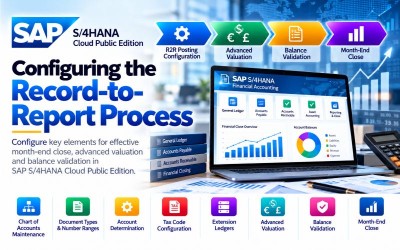
Configuring the Record-to-Report Process is a comprehensive SAP S/4HANA Financial Accounting (FI) training program designed for SAP FI Consultants, Finance Managers, Financial Accountants, SAP Functional Consultants, ERP Consultants, SAP S/4HANA Implementation Specialists, Controllers, Business Analysts, System Administrators, and finance professionals responsible for financial closing and reporting processes.
This course provides practical knowledge of Record-to-Report (R2R) configuration, Chart of Accounts Maintenance, Open Item Management, Account Determination, Document Types, Number Ranges, Field Status Groups, Reversal Reasons, Tax Code Configuration, Extension Ledgers, Advanced Foreign Currency Valuation, Payables and Receivables Reclassification, Balance Validation, and Month-End Closing.
Following SAP's official Learning Journey, learners will understand how to configure essential Record-to-Report settings, perform advanced valuation processes, execute balance validations, and support accurate month-end financial closing in SAP S/4HANA Cloud Public Edition.
The Record-to-Report (R2R) process is one of the core financial processes in SAP S/4HANA, enabling organizations to record financial transactions, maintain accounting structures, perform period-end activities, and generate accurate financial statements.
This course introduces the complete configuration of the Record-to-Report process, beginning with key financial accounting settings such as Chart of Accounts maintenance, account determination, document types, number ranges, field status groups, and tax code configuration. Participants will also learn how to configure Extension Ledgers, perform advanced foreign currency valuation, reclassify payables and receivables, execute balance validation rules, and resolve validation issues during month-end closing.
Learners will gain practical knowledge of SAP financial closing processes while following SAP best practices for compliance, financial reporting, and accounting accuracy.
By the end of this course, participants will be able to configure and manage the Record-to-Report process efficiently within SAP S/4HANA Cloud Public Edition.
Who Should Attend
- SAP FI Consultants
- SAP S/4HANA Finance Consultants
- Financial Accountants
- Finance Managers
- Controllers
- ERP Consultants
- SAP Functional Consultants
- SAP Implementation Consultants
- Business Analysts
- Financial Systems Administrators
- Internal Auditors
- Accounting Managers
- Financial Reporting Specialists
- SAP Support Consultants
- Finance Transformation Professionals
Skills You Will Gain
- Record-to-Report (R2R)
- Financial Accounting Configuration
- Chart of Accounts Maintenance
- Open Item Management
- Account Determination
- Document Types
- Number Range Configuration
- Field Status Groups
- Reversal Reasons
- Tax Code Configuration
- Extension Ledgers
- Foreign Currency Valuation
- Payables & Receivables Reclassification
- Balance Validation
- Month-End Closing
Career Opportunities
- SAP FI Consultant
- SAP S/4HANA Finance Consultant
- Financial Systems Consultant
- General Ledger Accountant
- Finance Transformation Consultant
- Financial Reporting Analyst
- ERP Finance Consultant
- Accounting Manager
- Financial Controller
- SAP Functional Consultant
- SAP Support Consultant
- Internal Controls Specialist
- Compliance Consultant
- SAP Implementation Consultant
- Finance Process Consultant
Certification Preparation
This course provides a strong foundation for professionals preparing for SAP S/4HANA Financial Accounting certifications involving financial closing, Record-to-Report processes, and financial configuration.
Participants will gain knowledge in:
- Record-to-Report Configuration
- Chart of Accounts
- Document Types
- Account Determination
- Extension Ledgers
- Foreign Currency Valuation
- Balance Validation
- Month-End Closing
- Financial Configuration
- SAP S/4HANA Finance
The course combines financial accounting concepts with practical SAP configuration exercises to prepare learners for real-world SAP Finance implementation and support projects.