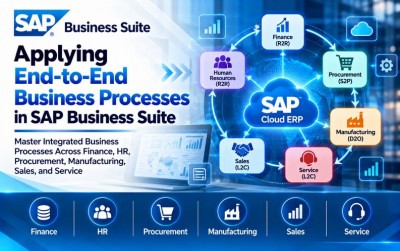
Applying End-to-End Business Processes in SAP Business Suite is a comprehensive business process course designed for SAP consultants, business analysts, ERP professionals, solution architects, business process owners, implementation consultants, functional consultants, and SAP certification candidates.
This learning journey introduces integrated end-to-end business processes within SAP Business Suite and SAP Cloud ERP. Learners explore how finance, human resources, procurement, production, sales, and service functions work together within a modern intelligent enterprise while understanding integration points across departments and SAP cloud solutions.
Modern organizations depend on integrated business processes to ensure seamless collaboration between departments and consistent information flow across the enterprise. SAP Business Suite enables organizations to manage these processes efficiently by connecting finance, procurement, manufacturing, sales, human resources, and service operations into a unified digital ecosystem.
This course provides a business-oriented understanding of SAP's end-to-end business processes. Participants will explore the architecture of the autonomous enterprise, learn the central concepts and business objects used throughout SAP solutions, and understand how major business processes such as Record-to-Report, Recruit-to-Retire, Source-to-Pay, Design-to-Operate, and Lead-to-Cash interact to support enterprise operations.
Learners will gain a holistic view of SAP Business Suite business processes and understand how integrated workflows improve operational efficiency, business visibility, collaboration, and decision-making.
Modern enterprises rely on integrated business processes to connect departments, automate operations, and improve decision-making. SAP Business Suite provides a unified platform where Finance, Human Resources, Procurement, Manufacturing, Sales, and Service work together through standardized end-to-end business processes.
This module introduces the core concepts of SAP Business Suite, enterprise process integration, intelligent enterprise architecture, SAP business objects, and the major end-to-end business processes that power modern organizations. Learners will understand how business data flows across departments and how SAP solutions support seamless enterprise operations.
This unit introduces SAP Business Suite and explains how integrated business processes connect departments across an enterprise. Learners will understand the importance of cross-functional collaboration, digital transformation, and intelligent enterprise operations supported by SAP solutions.
This unit explores the concept of the autonomous enterprise, where intelligent technologies, automation, analytics, and connected business applications work together to optimize business performance and decision-making.
This unit explains SAP business objects and their role in representing business entities such as customers, suppliers, materials, employees, purchase orders, invoices, and sales orders. Learners will understand how these objects support integrated business processes across SAP applications.
This unit introduces the Record-to-Report (R2R) business process, covering financial accounting, journal entries, general ledger management, financial closing, and management reporting. Learners will understand how financial transactions are recorded, processed, and reported within SAP.
This unit focuses on the Recruit-to-Retire process, explaining how organizations recruit, onboard, develop, manage, and retain employees using integrated Human Resources processes supported by SAP solutions.
This unit explains the Source-to-Pay (S2P) process, covering supplier sourcing, procurement, purchasing, goods receipt, invoice verification, and payment processing. Learners will understand how procurement activities integrate with finance and inventory management.
This unit introduces the Design-to-Operate (D2O) process, which connects product design, manufacturing, production planning, quality management, maintenance, and operational execution to support efficient manufacturing operations.
This unit focuses on the Lead-to-Cash process for sales organizations. Learners will understand customer acquisition, opportunity management, sales order processing, delivery, billing, and customer relationship management within SAP.
This unit explains how the Lead-to-Cash process applies to service-based organizations. Learners will explore service requests, service orders, resource planning, service delivery, billing, and customer support processes.
This unit brings together all the major end-to-end business processes and demonstrates how SAP Cloud ERP enables seamless integration across finance, procurement, manufacturing, human resources, sales, and service. Learners will understand how shared master data, real-time analytics, and integrated workflows support enterprise-wide decision-making.
Throughout this course, learners will complete hands-on exercises that simulate real-world business scenarios across Finance, Human Resources, Procurement, Manufacturing, Sales, and Service using SAP Business Suite and SAP Cloud ERP concepts.
These practical activities help learners understand how end-to-end business processes interact across departments and how data flows through an integrated enterprise.
Participants will perform the following practical exercises:
In this capstone project, learners will simulate the implementation of integrated business processes for a fictional global manufacturing and services organization using SAP Business Suite concepts.
Participants will analyze business requirements, map enterprise processes, integrate departments, and understand how information flows seamlessly across Finance, Human Resources, Procurement, Manufacturing, Sales, and Service operations.
Configure and analyze:
Execute:
Implement:
Analyze:
Upon successful completion of this project, learners will be able to: